How does tandem skydiving work? You are clipped by a harness to a qualified instructor, you fly up to around 4,000 m, you leave the aircraft together, you enjoy roughly fifty seconds of freefall, then you glide down for 5 to 7 minutes under a large two-person parachute to a soft landing. No experience is needed: your instructor handles the exit, stability, opening and landing, and you simply enjoy it. Here are the 8 steps of your jump day, just as our instructors live them every day of the season on our tandem skydive in Beni Mellal.
At a glance: a tandem skydive in 8 steps
- Arrival, check-in and weigh-in (be there 30 minutes before your slot)
- Ground briefing with your instructor
- Kitting up: harness, jumpsuit, helmet and goggles
- A 15–20 minute climb in a Pilatus PC-6 to around 4,000 m
- Exit from the aircraft, attached to your instructor
- About 50 seconds of freefall
- Opening at about 1,500 m and 5 to 7 minutes under canopy facing the Atlas
- Legs-up landing, watched by your friends and family
What is a tandem skydive? You, an instructor and a parachute built for two
A tandem skydive is a skydive for two: you wear a passenger harness attached at four points to a tandem instructor, who wears a parachute system designed for two people. No experience is needed – a ground briefing is enough, and your instructor flies everything from the exit to the landing.
A tandem is a wonderful gateway to freefall: the thrill of a real jump from 4,000 m, without a long course. The instructor's rig holds two parachutes sized for two people: a main and a reserve. Before the exit, your harness is attached to the instructor's at four points, two at the shoulders and two at the hips.
What sets a tandem apart from a first solo freefall jump:
| Tandem skydive | AFF first jump (your first solo freefall) | |
|---|---|---|
| Who opens the parachute? | The instructor | You, supervised by two instructors |
| Ground training | A briefing | Half a day of ground school |
| Flying the canopy | The instructor (you can often have a go) | You, guided by radio |
| Who is it for? | Anyone, no experience required | People who want to learn the sport |
What is a tandem master? The instructor who jumps with you
A tandem master, or tandem instructor, is an experienced skydiver holding a specific rating that allows them to take a passenger. In the United States, federal rules require at least 3 years in the sport and 500 freefall jumps before anyone can be in command of a tandem. Your safety rests on their experience, not yours.
"Tandem master" is the everyday name; officially it's a tandem instructor. Behind the title lies a long road:
- solid experience: US federal regulations, for example, require a minimum of 3 years in parachuting and 500 freefall jumps on a ram-air canopy, a "master" level licence and a tandem instructor course (14 CFR § 105.45);
- training on the specific system: every instructor is trained on the exact tandem rig they use;
- a rating beyond the licence: in France too, taking a passenger requires a dedicated tandem qualification on top of a skydiver's licences.
PACMA is a club approved by the French Parachuting Federation (FFP): instruction follows the FFP's rules of practice, and every tandem rig is fitted with an automatic activation device (AAD) – a small unit that opens the reserve automatically if nobody has done so by a set altitude. Weather calls are made by the chief instructor, Omar Benizi, a skydiver since 1975. To dig deeper into these safeguards, read is skydiving safe?.
Your job boils down to a few positions learned in the briefing. Everything else is the tandem instructor's responsibility.
How does the day at the dropzone run?
Allow half a day on site, in the sun by the runway, for ten minutes or so of pure exhilaration between leaving the aircraft and landing. You arrive 30 minutes before your slot for check-in, the weigh-in and the briefing, you kit up, then you wait for your lift, which depends on the wind, the clouds and how many people are jumping that day.
Here is a typical schedule. Timings are only a guide: the weather and the order of the lifts shift things around.
| Time | Stage | What happens |
|---|---|---|
| Slot − 30 min | Arrival | You reach Beni Mellal airport and get a first look at the runway and the aircraft |
| Slot − 15 min | Check-in | Booking checked, medical certificate, weigh-in |
| Slot | Briefing | With your instructor: exit, body position, landing |
| Next | Kitting up | Harness fitted, jumpsuit, helmet and goggles |
| Varies | Waiting | Your turn on the manifest, depending on wind, cloud and schedule |
| T | Boarding | You board the Pilatus PC-6 with your instructor |
| T + 15–20 min | Exit | Around 4,000 m reached, you leave the aircraft |
| About 1 min later | Opening | Freefall ends, parachute opens at about 1,500 m |
| 5–7 min later | Landing | Touchdown on the landing area, short walk back to the hangar |
Step 1: arrival and check-in
Here in Beni Mellal, the dropzone is right on the airport, at the foot of the Middle Atlas. You are welcomed beside the runway, you watch the Pilatus take off and land, and licensed skydivers pack their parachutes in front of you. This is often the moment that reassures people most: you see a busy club run by calm, methodical people.
Check-in is quick:
- your booking is checked, or your gift voucher;
- a medical certificate confirming you are fit to skydive; if you don't have one, you can see the club doctor on site (200 MAD);
- a weigh-in, fully dressed, because weight is a safety limit – everything is explained in our guide to the skydiving weight limit;
- the usual paperwork is signed.
Friends and family are very welcome. They can follow your jump from the edge of the runway, watch you land and share the lunch served under the traditional caidal tent (70 MAD).
Step 2: the briefing
The briefing is the only point in the day when you are asked to learn anything. It takes place on the ground, often wearing a harness. Your instructor walks you through four key moments:
- Your position in the door: sitting at the edge, hands holding your harness straps at chest level, head tilted back onto the instructor's shoulder.
- The freefall position, known as "the banana" or "the arch": hips pushed forward, back arched, legs bent back between the instructor's legs. This arch keeps the pair stable and belly-to-earth.
- The signal to release your arms: a tap on the shoulder shortly after exit. You can then spread your arms wide.
- The landing position: legs lifted and held out straight in front of you, as though sitting on the floor, so the instructor can land you both.
Ask anything that comes to mind: your instructor repeats, makes you rehearse and checks, with a smile. By the end, you can do each position with your eyes closed, and you're ready.
Step 3: kitting up
Your instructor or a member of the team fits your passenger harness: leg straps, chest strap, shoulder straps. It is snug on purpose; a well-adjusted harness won't shift in freefall and stays comfortable under the parachute. The club provides the jumpsuit, harness, helmet and goggles, which fit over prescription glasses if you need them. You just turn up in sportswear and well-laced trainers – the full list is in our guide on what to wear skydiving.
Waiting for the weather
Skydiving is enjoyed under a good sky, and the chief instructor picks the best moment for every lift according to wind on the ground and at altitude, cloud cover and visibility. If conditions deteriorate, we simply wait. And if the weather stops jumping that day, you lose nothing: your jump is rebooked free of charge for another date in the season, or converted into a credit. Use any waiting time to watch other jumpers land: you will see exactly what you are about to do, and the excitement builds.
Step 4: the climb in a Pilatus PC-6 to around 4,000 m
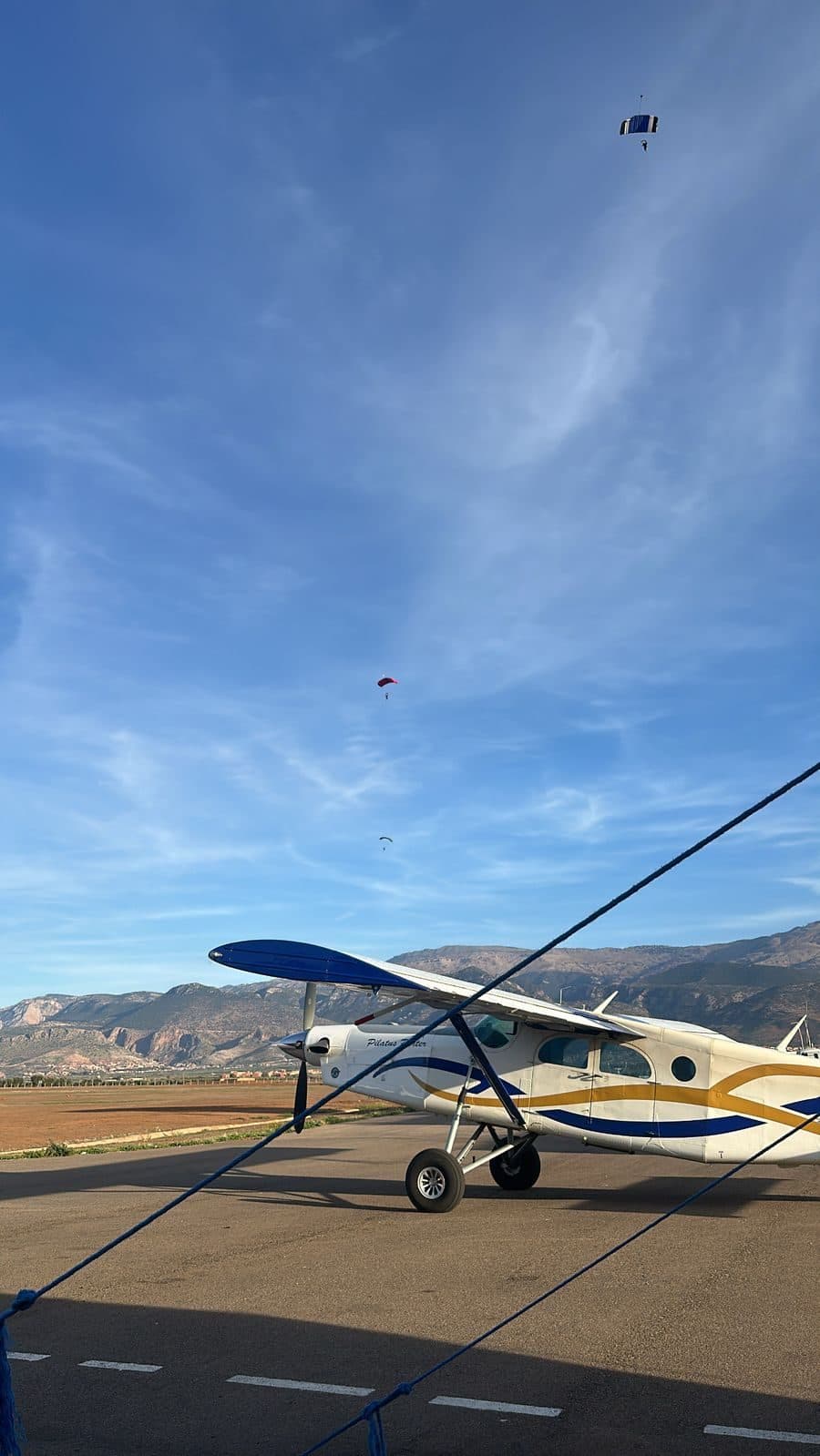
When your lift is called, you walk out to the Pilatus PC-6 Porter, a short take-off aircraft designed for mountain work that has become a skydiving classic. It carries nine skydivers plus the pilot. At PACMA, the aircraft are provided by our partner Vertical T'Air, a skydiving centre based in Arcachon, France. Its story is told in our article on the Pilatus PC-6 Porter.
What you see
The aircraft climbs in wide circles over the Tadla plain. The ride up takes 15 to 20 minutes – the longest part of the experience, and one of the most beautiful. Fields become a patchwork, the town of Beni Mellal shrinks, then the ridges of the Middle Atlas come level with the windows, often capped with snow in winter. The other skydivers on board laugh, joke and focus. The atmosphere is surprisingly relaxed.
What your instructor does
Your instructor isn't just admiring the view on the way up. At regular intervals, they:
- check their altimeter and call out the altitude;
- run through the briefing positions with you one last time;
- attach you to their harness at the four connection points, then tighten the straps;
- check your harness, their handles and their equipment;
- adjust your goggles just before the door.
If you have chosen the video option, filming starts in the aircraft. To find out whether it's worth it, see our guide to skydiving video.
As you approach the exit point, the pilot slows down and gives the signal. The door opens: fresh air rushes in and the noise of the engine and wind rises. This is an intense moment, when your heart beats faster, and it's exactly what makes the memory so precious. Your instructor is right there, attached to you, and knows this moment by heart. We've written a whole article about it: scared of skydiving? 9 instructor tips.
Steps 5 and 6: the exit and freefall – your only job
You shuffle to the door together, instructor behind you. You settle at the edge, hands on your harness, head back against their shoulder. They count – often "three, two, one" – and they make the exit. You don't have to "jump": you simply tip out of the door together.
The first few seconds
Right after the exit, your instructor throws out a small stabilising parachute called a drogue. It trails behind the pair, keeps you flat and stable, and limits your speed to that of a single skydiver. The drogue is what makes tandem freefall so stable and comfortable.
Your job: the banana
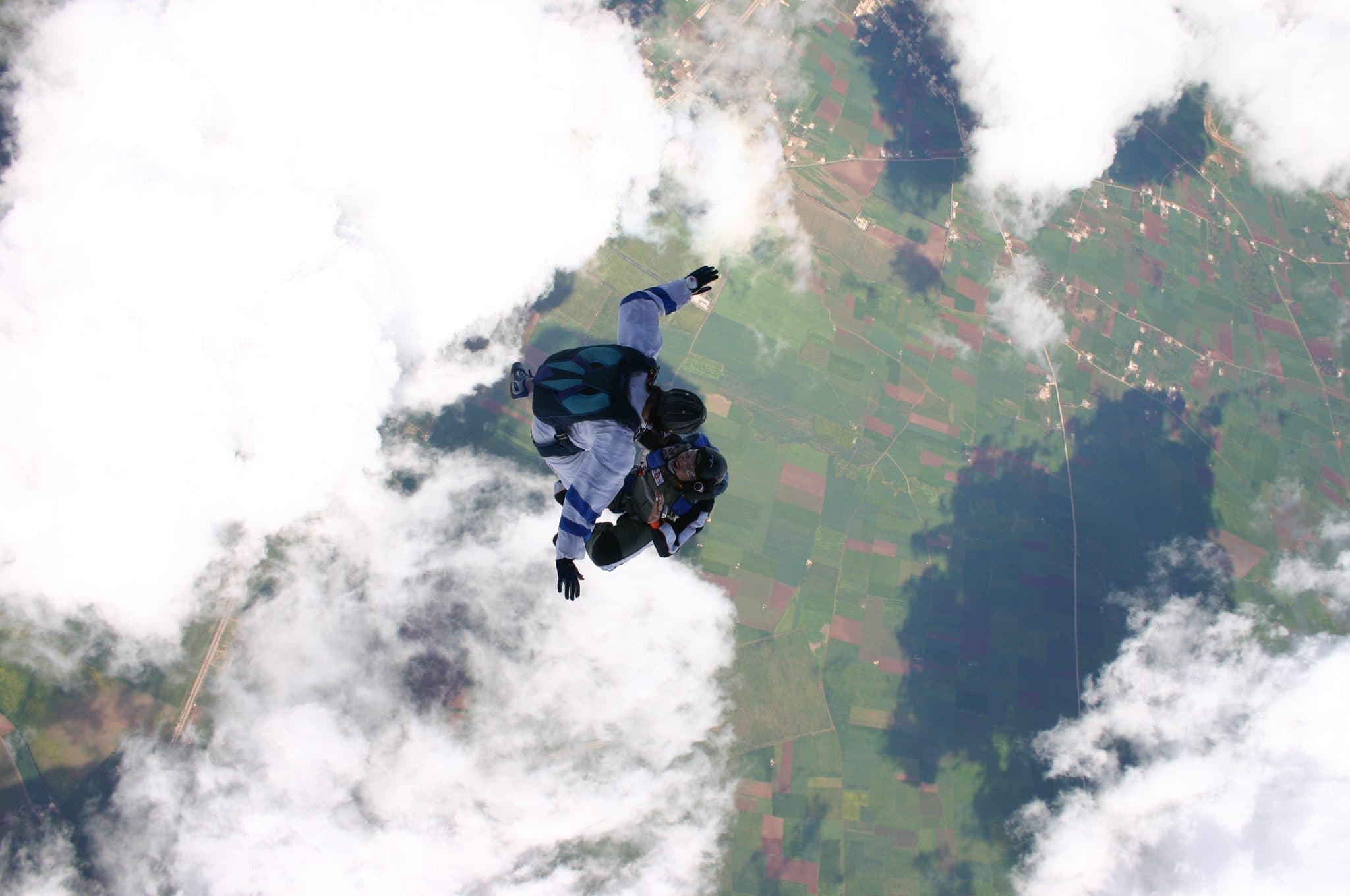
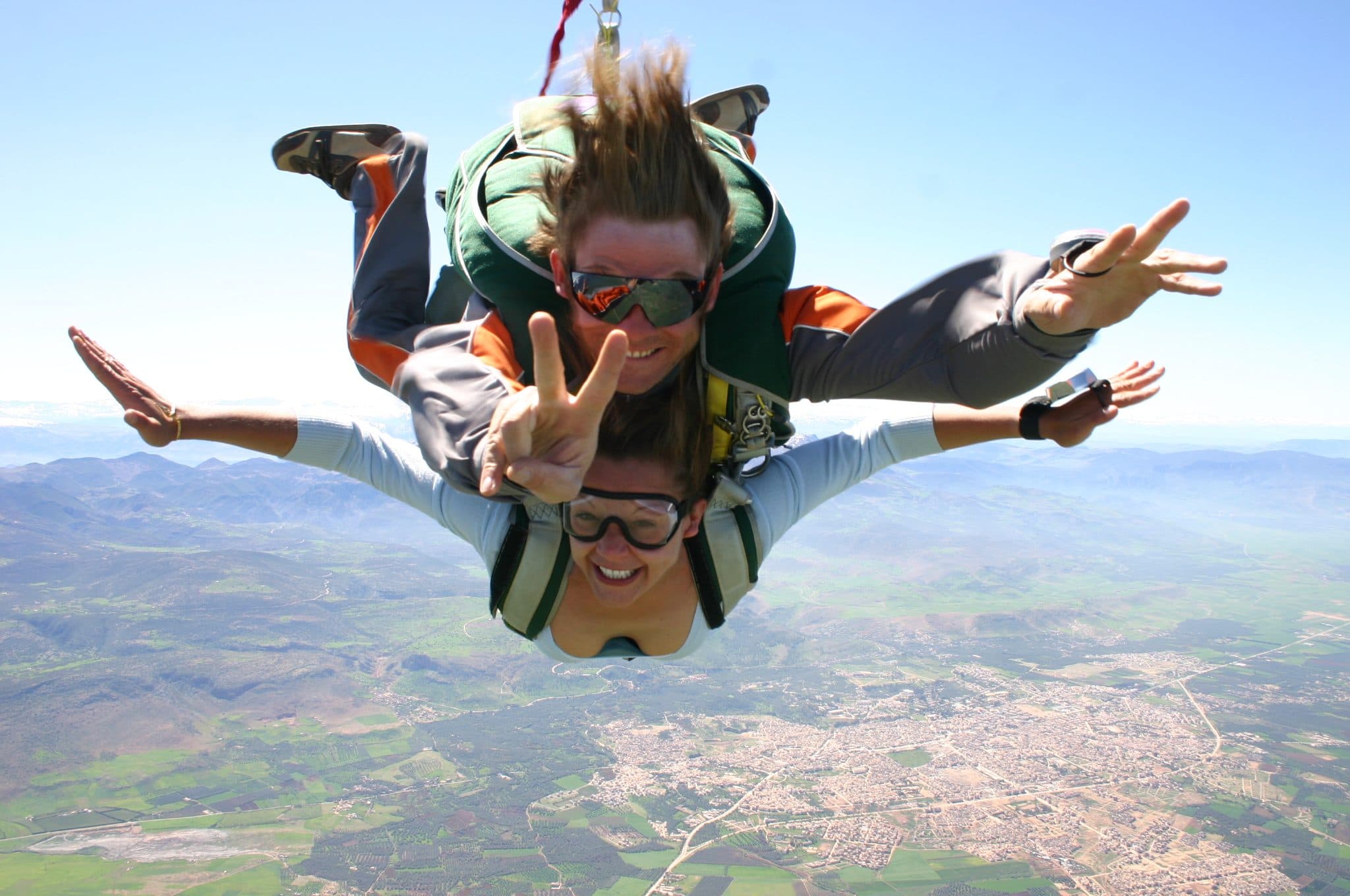
In freefall you have just one thing to do: keep the banana position – hips forward, head back, legs bent. When you feel the tap on the shoulder, spread your arms. Then enjoy it: the horizon, the line of the mountains, the camera if you are being filmed. Smile, shout if you like.
Freefall lasts about 50 seconds from 4,000 m. What it actually feels like – the wind, the noise, breathing – is covered in what does skydiving feel like, and the exact speed and timing figures are in how long is a skydive.
What your instructor does
Meanwhile, the instructor manages the pair's stability, watches the altimeter and keeps an eye on the airspace around you. They know your altitude at every second. You are free to savour every second.
Who pulls the parachute in a tandem? Step 7: opening and the canopy ride
Your instructor pulls the parachute, at about 1,500 m. The canopy unfurls over a few seconds, the pair slows down and you swing into a seated position. Then comes a 5 to 7 minute, near-silent flight, during which you can often take the toggles for a few turns.
The instructor pulls the handle that releases the drogue, which in turn pulls the main parachute out of the container. Once it's open, they loosen a few of your straps so you're comfortable. And if the main ever had a problem, the instructor has a reserve parachute, with the AAD as a last line of defence.
Calm after the wind
The contrast is magical: after the roar of freefall comes silence. You can chat normally with your instructor. It's the perfect moment to ask questions, look around and take in what you've just done.
Steering
A tandem canopy is a rectangular wing steered with two toggles, one in each hand. Pull right to turn right; pull both to slow down. If the wind allows, most instructors will offer you the toggles for a few turns. Ask for a spiral if you want more thrills, or a gentle glide if you'd rather take in the view. The instructor always takes back control for the approach.
The view over the Atlas
Under canopy the scenery is at its clearest. In Beni Mellal you have the Tadla plain on one side, the Middle Atlas on the other, its peaks often white in winter, and the runway and landing area beneath your feet.
Step 8: how does a tandem skydive landing work?
The landing is gentle: you lift your legs out in front of you and the instructor's feet touch down first. A few metres above the ground, they brake the canopy with both hands (the "flare"), so you arrive at roughly walking pace, either on your feet or sliding across the grass.
As you near the ground, your instructor reminds you of the position: legs lifted and held straight out in front, knees together, as though sitting on the floor. Depending on the wind and the ground, they will land you both on your feet, walking a few steps, or in a gentle slide on your bottom.
Why is it so gentle? Because the canopy is a wing. During the flare it converts its speed into lift and the pair slows dramatically. Your role is simple but decisive: keep your legs up until you've come to a complete stop. Practise the night before, sitting on the floor with your legs straight – our first-time skydiving tips explain how.
Once you're down, the instructor unclips you. Most passengers need a few seconds to take it in – and then can't stop talking, grinning from ear to ear.
After the jump: debrief, footage and what comes next
The debrief
Back at the hangar, your instructor talks you through the jump: your body position, the view, the opening, the steering. The questions come thick and fast: "How do you become an instructor?" "Can I jump on my own?" Whoever came with you will have watched the landing from the edge of the runway and will be waiting outside the hangar.
Your video and photos
With the video option, your edited film and HD photos are handed over the same day. It's the best way to relive those 50 seconds that your brain experienced on fast-forward, and to share them with everyone you love. Be sure to choose it when you book: that's when it's added to your jump.
What next?
A lot of people walk away from a tandem with the same idea: to do it again! There are two ways forward:
- another tandem, in different light or with friends – the Pilatus carries nine skydivers, so several tandems can go up on the same lift;
- your first solo freefall with an AFF first jump: your very first skydive on your own parachute, accompanied in freefall by two instructors, after half a day of ground school. It's the first step towards a skydiving licence. To choose, take our tandem or AFF quiz.
Why do your tandem in Beni Mellal this winter?
Because you jump in the sunshine, in the heart of winter: from 5 December 2026 to 4 April 2027, every day from 8:30 am to 6 pm, facing the often snow-capped peaks of the Atlas. A tandem costs €250 (2,500 MAD for Moroccan residents), 2 hours by road from Casablanca and 2 hours 30 from Marrakech, with an FFP-approved club founded in 2000.
Here in Beni Mellal PACMA – the Parachute Air Club du Maroc – was founded in 2000 by Karim Zaz and Omar Benizi and settled permanently in Beni Mellal in 2003. An FFP-approved club, it flies a Pilatus PC-6 all season. The aircraft takes off right in front of the hangar, and you land a few dozen metres from the tent where your friends and family are waiting. And if the weather calls for it, your jump is rebooked free of charge: you book with total peace of mind.
All the requirements (weight, age, health) are on our tandem skydive page, and practical questions are answered in our FAQ. Ready to experience those 50 seconds facing the Atlas? Book your tandem skydive online in a few minutes, or give an unforgettable present with a gift voucher valid for the season.