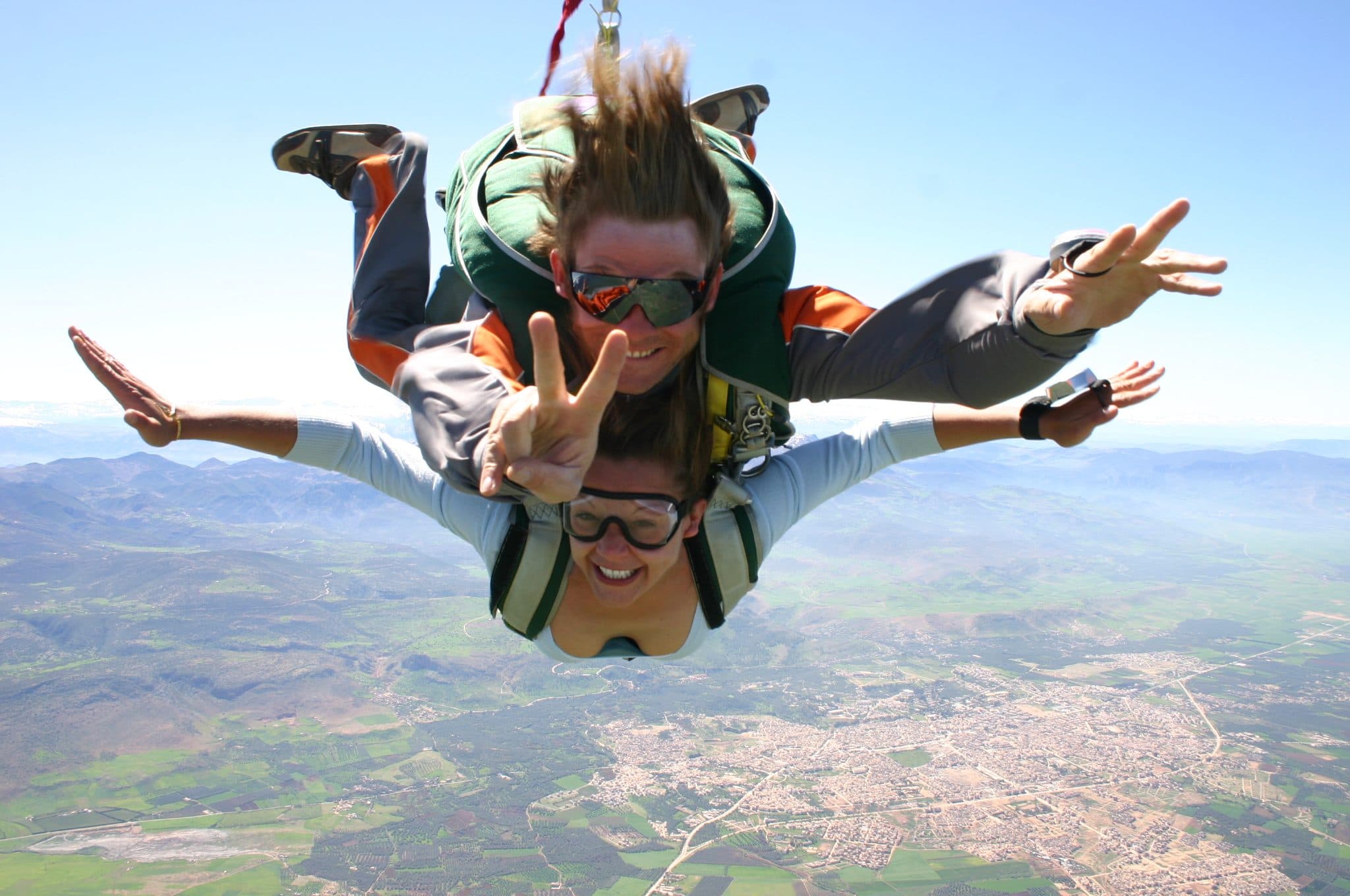
If you're scared of skydiving, you're in excellent company: almost every first-time jumper is, including the ones who won't admit it. Here's the great news: fear doesn't stop you jumping, it can be tamed, and it makes the pride you feel on landing even bigger. Every winter in Beni Mellal, our instructors welcome first-timers who arrive with butterflies in their stomachs and leave with a huge grin. On a tandem skydive there's nothing for you to decide or fly: a qualified instructor, attached to you, handles the exit, the 50 seconds of freefall, the opening and the landing. Here's what is really going on in your head, the most common fears set against reality, and 9 practical tips to help you reach the aircraft door calm and raring to go.
At a glance
- Being scared is normal: fear peaks before the jump, then fades in the first seconds of freefall.
- Fear of heights almost always disappears at 4,000 m: the ground becomes a map with no depth.
- On a tandem, your instructor does everything; you hold one position.
- You stay in charge at every moment: you're the one who chooses to live the experience.
Is skydiving scary?
A little, yes, and that's what makes it such a powerful experience: almost every first-timer has the jitters, especially the night before and at the aircraft door. Then, in the first seconds of freefall, that tension turns into sheer wonder. On a tandem you're attached to an instructor who takes care of everything: your only job is to enjoy it.
It isn't the fall that gets to people most – it's the waiting. So the tips below help you enjoy the hours before the jump and go through the door with a smile.
Being afraid is normal (and useful): what's happening in your brain
Your brain was not built to agree to leaving an aircraft. Faced with something unfamiliar and apparently dangerous, a small structure called the amygdala sounds the alarm. Your adrenal glands release adrenaline and cortisol: your heart races, your breathing goes shallow, your palms sweat and your stomach knots. It's the "fight or flight" response – the same one our ancestors relied on when they met a predator.
Two things about this response matter:
- It's useful. It sharpens your attention. A slightly nervous passenger listens better in the briefing and remembers the positions better than one who's far too relaxed.
- It anticipates rather than measures. Your brain is reacting to the idea of the jump, not the jump itself. That's why skydiving anxiety often peaks the night before, in the car or at the aircraft door – and then drops away almost instantly once you're out.
So you don't need to stop being afraid in order to jump: you just stay in the driving seat and let the adrenaline work for you. That's exactly what the tips below help you do.
The 5 most common fears – and the reality
The same questions come up in every briefing. Here they are, with the reality, which is far more reassuring than your imagination.
| The fear | The reality |
|---|---|
| "What if the parachute doesn't open?" | A tandem rig carries two parachutes, and an automatic activation device opens the reserve if needed. |
| "I'll get vertigo." | Vertigo comes from the contrast between a nearby reference point and the ground. At 4,000 m, that reference point no longer exists. |
| "I won't be able to breathe." | You breathe normally in freefall. The breathless feeling comes from nerves, not from the air. |
| "I'll freeze at the door." | There's nothing to decide at the door: your instructor counts and carries out the exit. |
| "I'll get hurt on landing." | A tandem canopy is a wing that slows right down when flared. You touch down at walking pace, legs up. |
The fear that the parachute won't open
It's the oldest fear and the most logical. A tandem has not one parachute but two, plus an automatic activation device that monitors altitude and descent rate. Your instructor is trained in emergency procedures, and the equipment is maintained and inspected under strict rules. For the figures and the full explanation, read our article is skydiving dangerous?. Understanding this safety system is often what turns worry into confidence.
The fear of "getting it wrong"
People admit to it less, but it's common: fear of forgetting the positions, screaming, crying, looking silly. Relax. Your instructor has seen it all. They'll remind you of each position at the right moment, in a friendly, supportive atmosphere. Whooping with joy as you leave the aircraft is positively encouraged!
Does a fear of heights stop you skydiving?
No, in the vast majority of cases, and it's one of the loveliest surprises of the jump. Vertigo comes from the contrast between a nearby reference point and ground that still has visible depth, as on a balcony. From an aircraft at 4,000 m, the ground becomes a flat map: there's nothing left to compare. Many passengers prone to vertigo are amazed to feel nothing but wonder at the view.
The explanation in detail: vertigo kicks in when your brain compares a nearby reference point – the edge of the balcony, your own feet – with ground that is far away but still readable in depth. That mismatch creates the feeling that the ground is pulling you in. From an aircraft at 4,000 m (13,000 ft), there's no perceptible depth left: the ground becomes a map, a flat landscape. There's nothing to compare, so no vertigo.
In freefall the effect is even clearer: you don't get the falling sensation of a fairground ride, because the air is holding you up. Exactly what you feel is covered in what does skydiving feel like?.
It's worth separating vertigo – a physical sensation tied to visual cues – from acrophobia, a severe and sometimes paralysing phobia of heights. If you have a diagnosed phobia, talk to the team before you book: we'll take the time to look at your situation with you.
Before the big day: get informed, visualise, breathe
Fear feeds on the unknown; confidence feeds on preparation. The first four tips mean you arrive at the drop zone on familiar ground.
Tip 1: know exactly what's going to happen
The better you know the sequence of events, the fewer scenarios your brain invents. Read our step-by-step account of how tandem skydiving works: from arrival to debrief, there'll be no surprises left. Browse the club FAQ for the practical questions, too.
Tip 2: choose a centre you trust
How calm you feel depends a lot on how much you trust the people looking after you. Find out how long the club has been running, how instructors are qualified, what equipment they use. PACMA is a club approved by the French Parachuting Federation (FFP): instruction follows the FFP's rules of practice, and every rig has an automatic activation device. Ask us all your questions by phone or at the desk: we're happy to answer, and it's the first step towards a relaxed jump.
Tip 3: visualise the whole jump, right through to landing
Elite athletes use visualisation to prepare for high-pressure moments. Do the same. Eyes closed, run the scene: the door opening, your instructor's count, the banana position, the tap on the shoulder, your arms spreading, then the calm under the canopy and your legs up for landing. Always go all the way to the end, until you're on the ground and smiling. Your brain gets used to the script and gradually files it under "familiar".
Tip 4: learn one simple breathing technique
Slow breathing calms the nervous system. The easiest technique to remember: breathe in through your nose for five seconds, then out slowly through your mouth for five seconds, for a few minutes. Practise in the days beforehand so it's automatic on the day. For the rest of your preparation – sleep, food, what to wear – follow our first-time skydiving tips.
Some people also book an indoor skydiving session first to get used to the feeling of the wind. It isn't necessary, but if the idea reassures you, our comparison of indoor skydiving vs a real skydive will help you decide.
Good news for worriers: you only jump in good conditions, and if the weather is bad, your jump is rebooked free of charge. You can book your tandem with a light heart.
On the plane and at the door: the hardest moment
Ask any skydiver: the most intense moment isn't the freefall, it's the door. The climb takes around a quarter of an hour, the excitement rises with the altimeter, then the door slides open and the wind rushes into the cabin. That's peak adrenaline, just before the reward. Here's how to make the most of it.
Tip 5: talk to your instructor
Tell them you're scared. It's valuable information, and you're far from the first to share it. They'll know when to reassure you, when to crack a joke and when to leave you be. Ask about the scenery or how they got into the sport: conversation keeps your mind busy.
Tip 6: look far away, not straight down
On the plane, look out of the window at the horizon and the mountains rather than the ground directly beneath you. In Beni Mellal, the ridges of the Middle Atlas – often snow-capped in winter – make an ideal focal point. Looking into the distance steadies your inner ear and calms you down.
Tip 7: breathe out hard as you leave
The stress reflex is to hold your breath. At the door, do the opposite: breathe out long and slow, or shout. A yell as you leave the aircraft releases tension and gets your breathing going again. It's why so many skydiving videos start with a huge "woooo".
Tip 8: focus on one single task
At the door, your brain needs just one instruction: head back, hips forward, hands on your harness. Repeat it in your head. A simple task to carry out leaves little room for panic. And you don't have to decide when to go: your instructor counts and makes the exit. Your only job is the position.
What if I freeze at the door? Can you back out of a skydive?
Yes, the choice stays yours right to the end, even at the door: you simply stay on board and fly back down with the aircraft. In practice, freezing is rare, because on a tandem there's nothing to decide: you're sitting at the edge of the door, head back, and your instructor counts and makes the exit. All you have to do is let yourself go.
What helps most is saying so beforehand: tell your instructor at the briefing that you're worried about freezing. They'll know how to prepare you and when to remind you of the position. For the full logistics of the day, have another look at how tandem skydiving works.
What our instructors tell every first-timer
Season after season, the club's instructors say the same words to passengers with the jitters. They make up the final tip, and the most liberating one.
Tip 9: trust the process
- The fear stops at the door. In the vast majority of cases, nerves vanish in the first seconds of freefall and wonder takes over. Your brain no longer has time to anticipate: it's busy living it.
- You're never alone. Your instructor is attached to you for the whole jump. They handle altitude, stability, opening and landing.
- The bravest person isn't the one who isn't scared. It's the one who gets on the plane while scared. If you're on board, the hardest part is done.
- You decide. An instructor never pushes out a passenger who doesn't want to go. Knowing that you stay in control of that decision is often enough to set you free.
The club's president and chief instructor, Omar Benizi, has been skydiving since 1975 and has made around 14,000 jumps. Every one of our team started with a first jump, with the same knot in the stomach as you. They know exactly how you feel, and they love watching those nerves turn into pride.
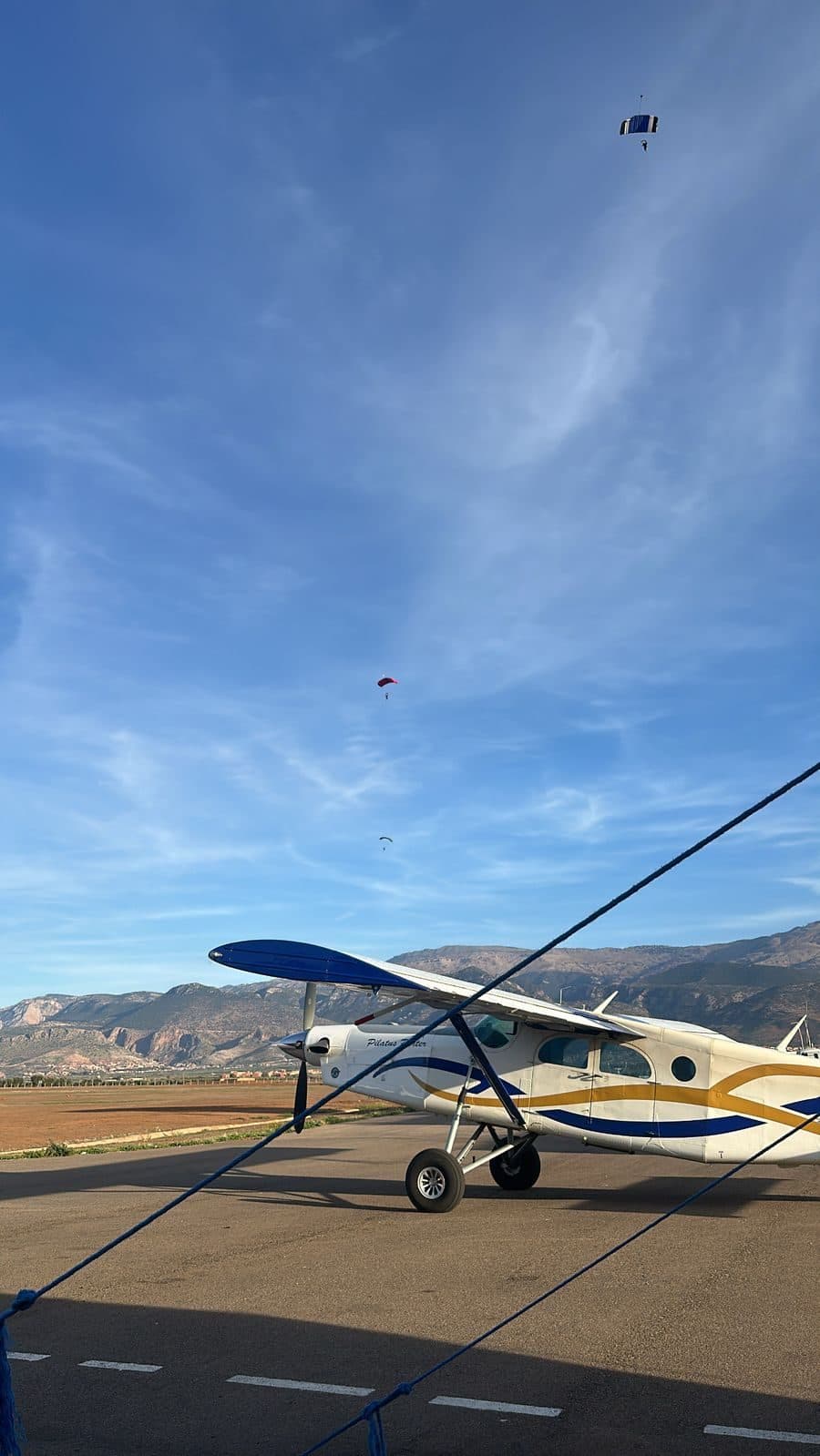
Here in Beni Mellal If nerves keep you awake the night before, come early on jump day. Watching other passengers land from the edge of the runway, seeing their faces as they emerge from under the canopy, chatting with them over the buffet in the caidal tent: that's often when anxiety turns into impatience.
Ready to turn your fear into a memory you'll be proud of? Around 50 seconds of freefall from 4,000 m, then 5 to 7 minutes under canopy facing the Atlas: discover our tandem skydive and book your jump online for the season, from 5 December 2026 to 4 April 2027.