
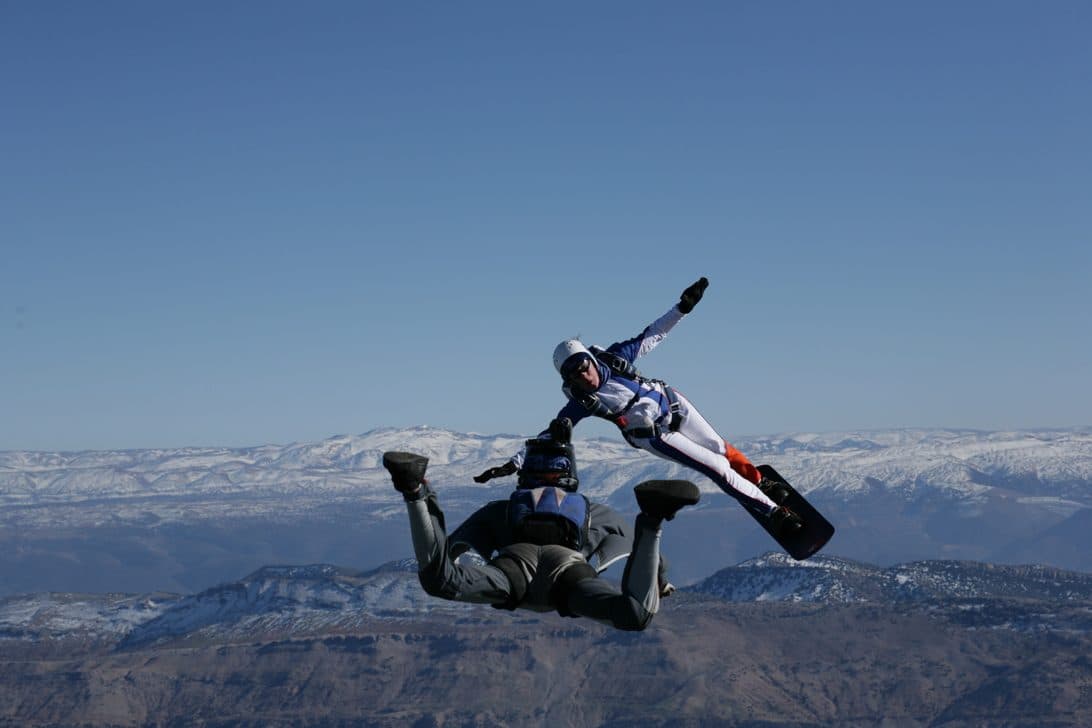
How cold is it at 13,000 feet?
Work out the temperature up there in 10 seconds.
Enter the ground temperature and the exit altitude: the tool applies the standard atmosphere lapse rate, then estimates the wind chill in freefall. Ideal for choosing what to wear and turning up to your jump perfectly kitted out.
The short answer
About −11 °C (13 °F) in the standard atmosphere: temperature drops by 6.5 °C every 1,000 m, so at 13,000 feet (3,962 m) the air is about 26 °C colder than at sea level. Above Beni Mellal in January, expect around -7.9 °C at exit altitude, against a mild average afternoon high of 18.1 °C on the ground.
- FFP
- club approved by the French Parachuting Federation
- 2000
- year the club was founded, in Beni Mellal since 2003
- PC-6
- Pilatus Porter, 9 skydivers per lift
- ≈ 4,000 m
- exit altitude, ≈ 50 s of freefall
Calculator
Your temperature at exit altitude
Start from a reference or enter today's temperature.
As on your altimeter, set to zero on the ground. At PACMA: about 4,000 m (13,000 ft).
Estimated temperature every 500 m
| Altitude above the ground | Estimated temperature |
|---|---|
| Ground | 15.0 °C |
| 1,000 ft | 13.0 °C |
| 2,000 ft | 11.0 °C |
| 3,000 ft | 9.1 °C |
| 4,000 ft | 7.1 °C |
| 5,000 ft | 5.1 °C |
| 6,000 ft | 3.1 °C |
| 7,000 ft | 1.1 °C |
| 8,000 ft | -0.8 °C |
| 9,000 ft | -2.8 °C |
| 10,000 ft | -4.8 °C |
| 11,000 ft | -6.8 °C |
| 12,000 ft | -8.8 °C |
| 13,000 ft | -10.8 °C |
Calculation result
At 13,000 ft: -11 °C
that's 26 °C colder than on the ground.
At opening, around 1,500 m: 5 °C.
Wind chill in freefall (≈ 200 km/h)
At least as cold as -24 °C: that's the official wind chill table value at 60 km/h, its upper limit.
Extrapolated to 200 km/h, the formula gives -30 °C. It was never designed for that speed, so treat this figure as a rough guide.
Our tip: two thin layers under the jumpsuit we provide, trainers with the laces done up tight, and you're all set. Helmet and goggles are provided.
Book my tandem · €250An estimate: the real atmosphere often differs from the standard atmosphere (inversions, air masses). On the day, your instructors will tell you exactly what to wear.
Calculated in your browser: nothing is sent, nothing is stored.
Why is it colder at altitude?
Because rising air expands and cools, far from the ground that warms it. In the ICAO standard atmosphere, temperature falls on average by 6.5 °C per 1,000 m (about 2 °C per 1,000 ft), up to 11 km. Real air varies from day to day with humidity: this lapse rate is an average, not today's measurement.
What is the temperature at 13,000 feet?
About −11 °C (13 °F) in the standard atmosphere: 13,000 feet is 3,962 m, and the air there is about 26 °C colder than at sea level. For a realistic estimate, start from the temperature at your drop zone: above ground at 20 °C (68 °F), you get about −6 °C (22 °F) at 13,000 feet.
How cold is it at exit altitude over Beni Mellal in winter?
About -7.9 °C in January and -0.8 °C in April at 4,000 m above the ground, based on the average daily high in the 1991-2020 WMO climate normals. On the ground, afternoons stay mild: 18.1 °C on average in January, 25.2 °C in April. The best of both worlds: crisp high-altitude air for the freefall, then the mild Tadla plain for landing.
Beni Mellal, December to April: estimated temperature at altitude
| Month | Ground (average daily high) | At 1,500 m (opening) | At 4,000 m (exit) |
|---|---|---|---|
| December | 19.1 °C | 9.4 °C | -6.9 °C |
| January | 18.1 °C | 8.4 °C | -7.9 °C |
| February | 19.5 °C | 9.8 °C | -6.5 °C |
| March | 22.6 °C | 12.9 °C | -3.4 °C |
| April | 25.2 °C | 15.5 °C | -0.8 °C |
How cold does freefall feel?
Brisker than the air itself, because of the relative wind of about 200 km/h (125 mph). The official wind chill table stops at 60 km/h: for -7.9 °C, it already gives about -20 °C. Beyond that, the formula is no longer validated. Don't worry: freefall lasts about 50 seconds, and you wear a jumpsuit, helmet and goggles.
What should you wear to skydive in winter?
Two thin layers rather than a heavy coat, and trainers with the laces done up tight. We provide the jumpsuit, harness, helmet and goggles. Under the canopy the air warms up quickly as you descend: in January over Beni Mellal, about 8.4 °C at opening around 1,500 m, then an average afternoon high of 18.1 °C for a landing in the sun.
What are the limits of this calculation?
It gives an average. The real lapse rate varies with humidity and from day to day, and an inversion can make the air warmer aloft than on the ground. Wind chill is only defined below 10 °C, and the official table stops at 60 km/h. Use it to plan what to wear, not as a weather forecast.
Frequently asked questions
Is it cold when you skydive?
A little, and only for the freefall: at 4,000 m the air is about 26 °C colder than on the ground, and the freefall wind adds to the feeling. But it's over in a flash: about 50 seconds of freefall, then 5 to 7 minutes of canopy flight in air that keeps getting warmer.
What is the temperature at 3,000 m (about 10,000 ft)?
About −4.5 °C (24 °F) in the standard atmosphere, 19.5 °C colder than at sea level. That's around the altitude of the first AFF jumps, which start from 3,000 to 3,500 m under FFP rules.
How long is freefall from 4,000 m?
About 50 seconds of pure thrill, at around 200 km/h, until the parachute opens at about 1,500 m. Then come 5 to 7 minutes under canopy, plenty of time to take in the Middle Atlas.
Does the tool work in feet and Fahrenheit?
Yes: choose °C or °F, metres or feet. For reference, 4,000 m is 13,123 feet, and 13,000 feet is 3,962 m.
Where do the Beni Mellal temperatures come from?
From the 1991-2020 WMO climate normals for the Beni Mellal station (no. 60191), published by NOAA. We start from the average daily high, close to the warmest hours of a jump day.
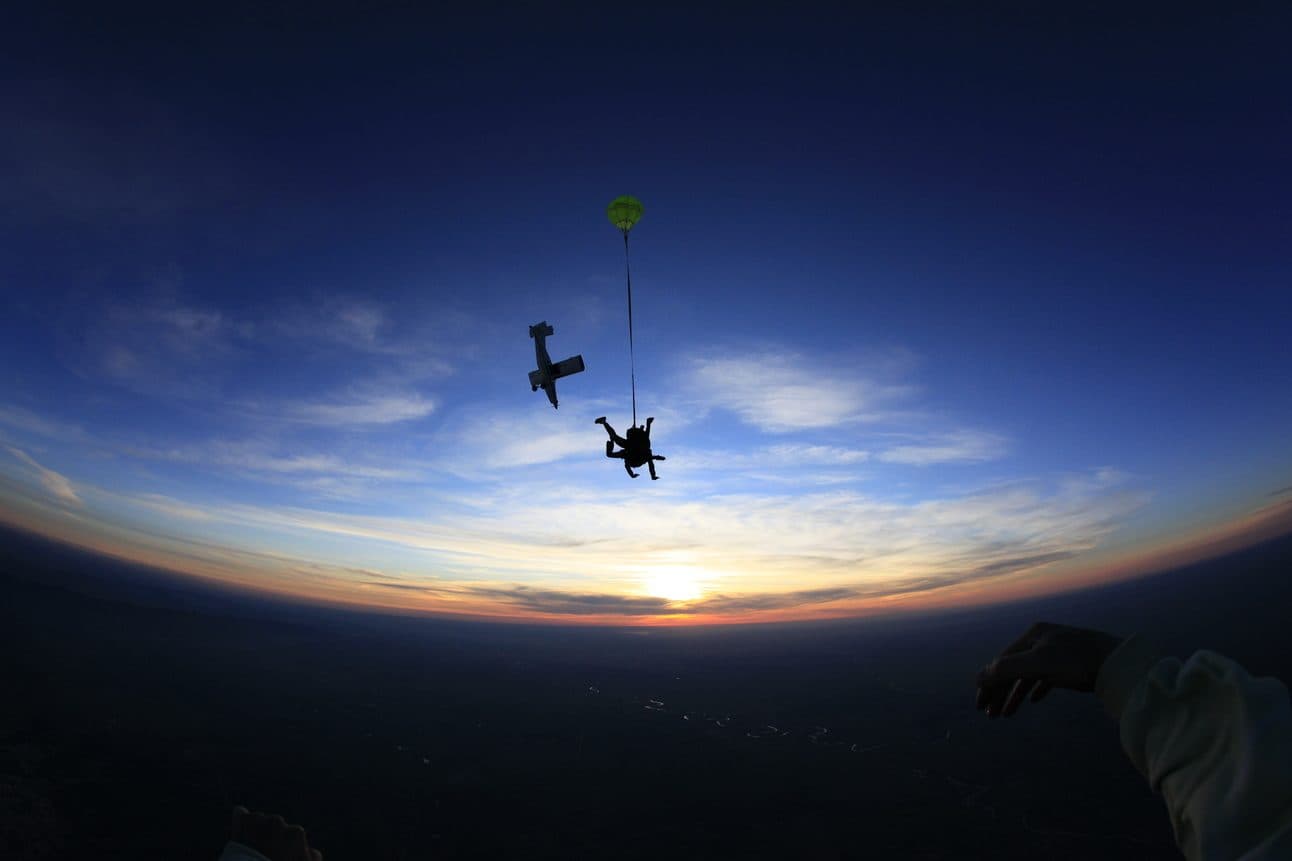
Live those 50 seconds above the Atlas.
Tandem skydive from 4,000 m, from 5 December 2026 to 4 April 2027, with an FFP-approved club. €250, with jumpsuit, helmet and goggles provided: all you have to do is turn up.