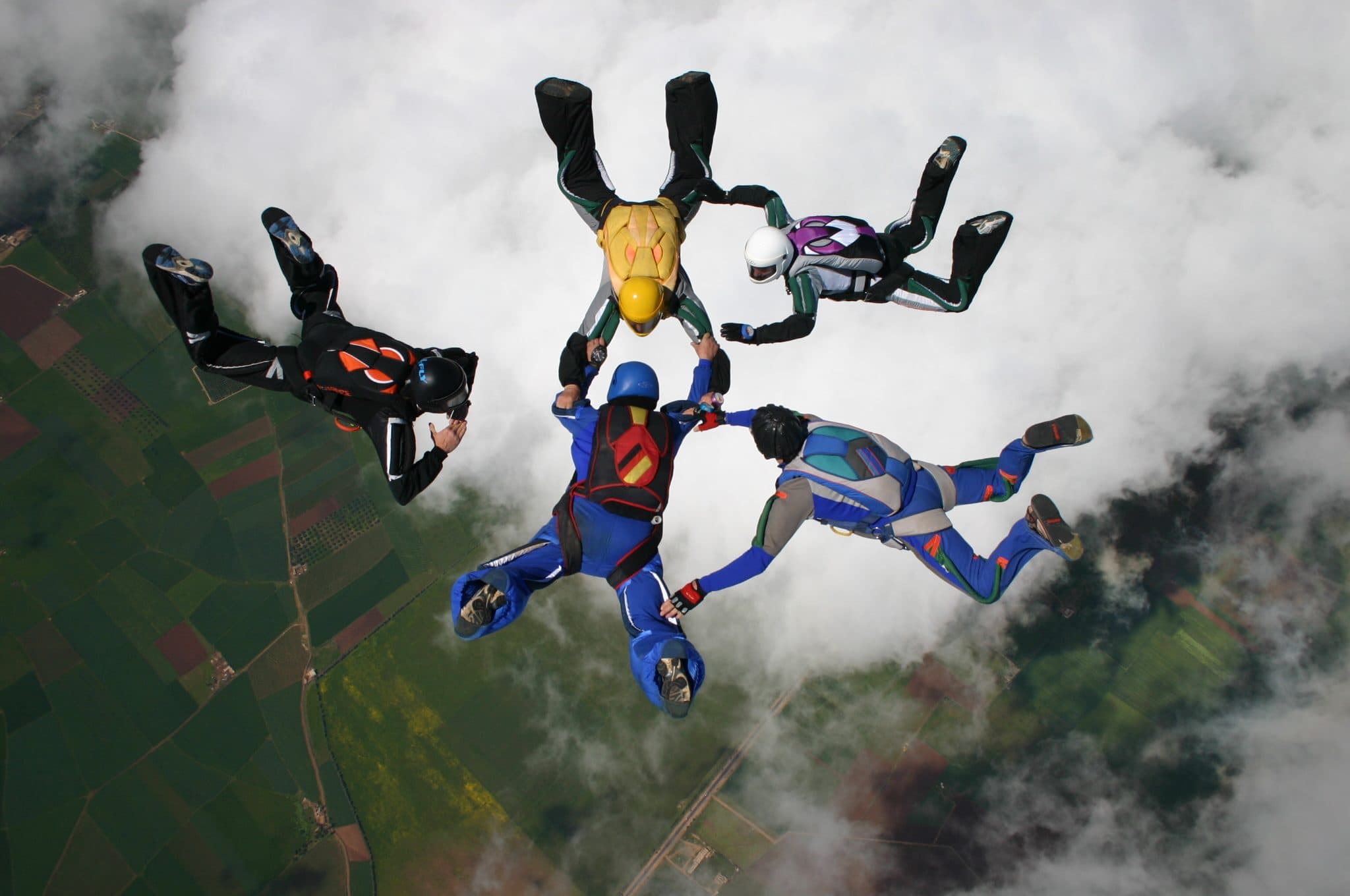
A skydiving licence is your passport to the sky: it certifies what you can do in freefall and under canopy, and every letter unlocks new freedoms. Jump on your own (A), fly in groups and pack (B), become fully independent (the BPA, in France), take on duties on board (C) or perform display jumps (D). The good news: the A licence needs at least 18 jumps with British Skydiving, 25 with the USPA and 12 (including 5 solo) with the French Parachuting Federation (FFP). This guide puts the three systems side by side, using rules checked in October 2026, with a converter to place your own level in one click.
Licence, membership, certificate: what is the difference?
In the UK and the US, a skydiving licence is your level of competence, and federation membership is paid separately. In France it is the other way round: the brevet is the qualification, held for life, while the licence is your annual FFP membership, insurance included. With both, the sky is yours.
Four words come up again and again:
- The licence (UK) or license (US) is your competence level, from A to D, issued under the rules of British Skydiving or the USPA.
- The French brevet is the equivalent qualification, issued by an FFP-approved school under the responsibility of its chief instructor. The French licence is the annual federation membership with insurance – your pass for the season, which must be valid whether you hold an A or a D.
- The FAI certificate (Certificate of Proficiency) is an international document, issued by your national federation on behalf of the Fédération Aéronautique Internationale. According to the FAI, each level (A, B, C, D) is validated with a sticker in a single booklet, numbered with the country code. It shows a level, not how recently you have jumped.
- Your logbook records every jump, signed by your instructors. It is your skydiver's calling card, all over the world.
A little trap worth knowing – the two meanings of "BPA": in the UK it was the British Parachute Association, now British Skydiving; in France it is the brevet de parachutiste autonome, the independent-skydiver qualification.
What is a skydiving licence called in other countries?
Every country has its own vocabulary, and the same word does not always mean the same thing. So you can travel with peace of mind, here are the terms you will see on school and dropzone websites, and what they usually cover.
| Country or language | Usual term | What it means |
|---|---|---|
| France, Belgium, Switzerland | brevet A, B, C, D; licence | The brevet is the level; the licence is annual membership and insurance |
| UK, Ireland | A licence, B licence… | Your competence level (British Skydiving) |
| USA | A license, B license… | Your competence level (USPA); membership is paid separately |
| Germany, Austria | Lizenz | The qualification that lets you jump solo, issued under national rules |
| Spain | licencia; título A | The licencia is often federation membership, the título the level |
| Italy | brevetto; licenza | The brevetto is the qualification |
| Netherlands, Flanders | A-brevet | Your competence level |
| Portugal | licença; brevet | Schools also talk about the "sport parachutist brevet" |
| Russia | удостоверение; свидетельство | The document certifying your skydiver qualification |
The good news is that the logic is the same everywhere: whatever the word, a dropzone abroad will ask for your level (licence or brevet), valid membership and insurance, and your logbook. With those three documents, you can jump all over the world.
France (FFP): A, B, BPA, C and D
The French requirements are set by the FFP's technical directive no. 49, version of 27 March 2026.
| Level | Prerequisite | Main requirements | What it lets you do |
|---|---|---|---|
| A | AFF (PAC) Level 4 or static-line Level 5 | At least 12 jumps, 5 of them solo; freefall, canopy and theory sign-offs | Jump alone, without instructor assistance, at an approved school |
| B | A | At least 22 jumps; freefall (Bc), canopy (Bv) and packing (Bp) modules | Access to specialist qualifications; deployment allowed from 1,000 m |
| BPA | A specialist qualification (B1 to B5) | At least 100 jumps, aged 18+ | Independent jumping, coordinating the jump run, access to freefall camera |
| C | BPA | At least 200 jumps, aged 18+ | Pre-boarding gear checks, supervising advanced students on board, access to instructor courses |
| D | BPA | At least 300 jumps | Display and special jumps |
How many jumps for the FFP A?
At least 12 freefall jumps, at least 5 of them solo, with skills signed off in freefall, under canopy and in theory – a very achievable goal in one well-filled season. The French A follows AFF (PAC) Level 4, or static-line Level 5, and gives you a wonderful freedom: jumping alone, without instructor assistance, at an approved school.
The skills to sign off: flat 360° turns in one direction then the other, holding a heading 90° to the jump run, a five-second "arrow" (forward movement), a stable exit; under canopy, a stall, turns, 360s and landing unassisted. A theory review (equipment, safety on board, incidents, emergency procedures) and the basics of packing complete the list. Until the canopy module is signed off, ground wind is limited to 7 m/s.
The French B and specialist qualifications
The B needs at least 22 jumps and three modules: freefall (tracking, moves around all three axes, a forward-facing exit), canopy (landing in a 40 × 80 m area, stacking in a group, an S-shaped approach) and packing (a full pack job supervised by an instructor). The minimum deployment height drops from 1,200 m to 1,000 m.
The B opens the door to specialist qualifications, and that is where skydiving becomes a team game, in groups and in competition:
- B1: accuracy and style;
- B2: formation skydiving, signed off after at least 8 specific training jumps;
- B3: canopy formation;
- Bi4 and B4: freefly and freestyle, in modules (belly and back tracking, head-up, then head-down);
- Bi5 and B5: canopy piloting.
The BPA, independent skydiver qualification
This is the big independence milestone in France, the one every student dreams of: at least 100 jumps, a specialist qualification and being 18 or over. The BPA teaches you to coordinate the jump run with the pilot and to check your own kit and pack job, and gives access to independent jumping sessions and camera training. Until you hold it, a certified helmet and an RSL (which deploys the reserve after a cutaway) remain compulsory.
The French C and D
The C (BPA, 200 jumps, 18+) lets you check other skydivers' kit before boarding, supervise students from AFF Level 4 on board and access instructor courses. The D (BPA, 300 jumps) authorises display jumps; for a public air show you also need 15 jumps in the previous three months, 5 of them in the last month.
USA (USPA): A, B, C and D licenses
In the United States, the requirements are set out in the USPA's Skydiver's Information Manual, section 3.
| License | Jumps | Other requirements | What it lets you do |
|---|---|---|---|
| A | 25 freefall jumps | Signed A license proficiency card, written, oral and practical tests | Jump without supervision, pack your own main, jump in groups |
| B | 50 jumps | 30 min of freefall, 10 group jumps, 10 landings within 10 m of target, canopy proficiency card, water-landing training | Night jumps; coach rating from 100 jumps |
| C | 200 jumps | 60 min of freefall, 50 group jumps, 25 landings within 2 m | Instructor ratings (except tandem), some display jumps |
| D | 500 jumps | 3 hours of freefall, plus two of: night jump, 100 landings within 2 m, canopy formation, water jump, 100 group jumps | All USPA ratings |
Since 2018 the USPA has counted "freefall skydives" rather than just "jumps" for the A license, to align it with the FAI certificate (Parachutist, 2019). The American A license thus needs twice as many jumps as the French brevet A, and it immediately allows group jumps; the French system, for its part, makes you independent sooner, then opens up group jumping with the specialist qualifications.
UK (British Skydiving, formerly the BPA) and other countries
In the UK, the former British Parachute Association is now British Skydiving. According to its helpdesk (checked on 18 October 2026):
- A licence: at least 18 jumps, through AFF or static line, then consolidation; stable freefall, tracking, altitude awareness and safe deployments; competent canopy control with accurate landings; a written theory exam; endorsement by a Chief Instructor. On AFF, the British route runs to 8 levels followed by 10 consolidation jumps.
- B licence: at least 50 jumps, including 10 formation skydives with at least 3 other jumpers, Canopy Handling Grade 1 (CH1) and a B licence briefing.
- C licence: at least 200 jumps, CH2, plus a night jump or a display endorsement.
- D licence: the highest sport licence. British Skydiving's official pages do not all give the same jump number, so the safest move is to confirm it directly with the federation.
A British feature: to jump in groups you need a discipline sticker (FS1 for formation skydiving, FF1 for freeflying), a little like the French specialist qualifications.
Other countries have their own rules: most national federations issue their own licence as well as FAI certificates. Everywhere, progression follows the same rewarding logic: a first independence level, then steps that recognise your jumps and skills.
Comparison table and licence converter
There is no automatic official equivalence, but this table gives you an instant benchmark: it compares the minimum number of jumps published by each federation. Skills, for their part, are signed off by an instructor.
| Stage | France (FFP) | USA (USPA) | UK (British Skydiving) |
|---|---|---|---|
| First independence level | A (12 jumps) | A license (25 jumps) | A licence (18 jumps) |
| Solid basics, group jumping | B (22) then specialist qualifications | B license (50) | B licence (50) |
| Full independence | BPA (100) | — | — |
| Experienced | C (200) | C license (200) | C licence (200) |
| Displays, top of the system | D (300) | D license (500) | D licence (to be checked) |
Place your own level in each system in seconds: choose your licence or enter your number of jumps.