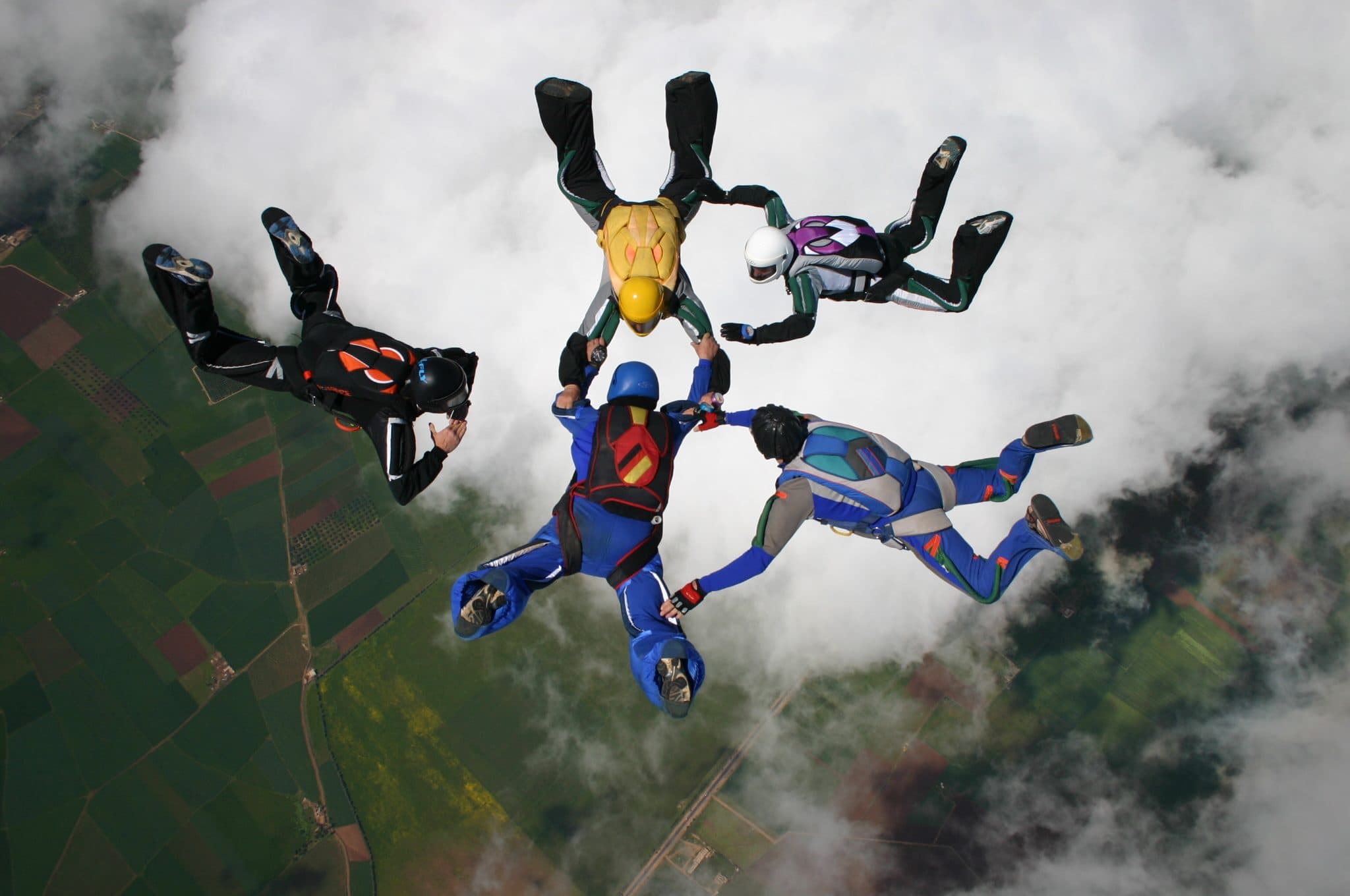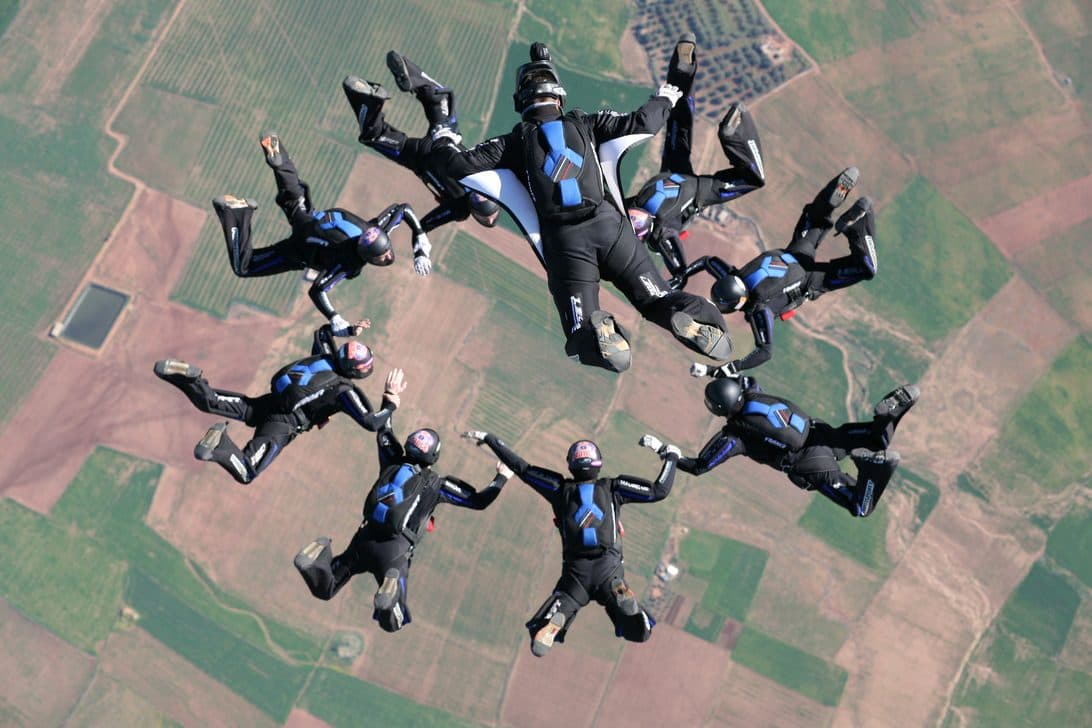
AFF levels take you, step by step, from your first jump held by two instructors to your solo: the big day when you fly freefall on your own. In France the method is called PAC and has just four levels, set by the French Parachuting Federation (FFP) – and as few as 7 jumps can get you to your solo! Here, jump by jump, is what you will learn, what your instructors are watching for, the pitfalls we help you avoid, and exactly how the French levels line up with AFF as taught in the United States and the UK.
What is PAC in skydiving?
PAC, or Progression Accompagnée en Chute, is the FFP's training method for learning to skydive solo, and it has plenty to get excited about: from your very first jump you leave from altitude with your own parachute, held by two instructors, and you deploy it yourself. It has 4 levels and requires at least 6 accompanied jumps before your solo.
The principle is magical: you experience real freefall from day one, with one or two instructors in the air who hold you, correct you with hand signals and release you when you are ready. The four levels are defined by the FFP's technical directive no. 49 (version of 27 March 2026). The alternative to AFF, the static-line method, is covered in our guide on how to learn to skydive.
PAC = AFF: the same method, sliced differently
Yes, PAC is the French equivalent of AFF (Accelerated Freefall), and your skills travel with you. The skills taught are very similar: position, altitude awareness, deployment, then independence in freefall. Only the way the course is divided changes: 4 levels with the FFP, 7 at most USPA-style AFF schools and 8 in the UK, followed by consolidation jumps.
| Stage of the progression | PAC (FFP) | 7-level AFF (USPA and schools on that model) | British Skydiving AFF |
|---|---|---|---|
| First freefall, student deploys | Level 1, 2 instructors | Level 1, 2 instructors | Level 1, 2 instructors |
| Stability, heading, exiting unheld | Level 2, 1 instructor | Levels 2 and 3, often 2 instructors | Levels 2 and 3, 2 instructors |
| Release, turns, independence in freefall | Level 3, 1 instructor who no longer holds you | Levels 3 to 6, 1 instructor | Levels 4 to 7, 1 instructor |
| First jump with no instructor in freefall | Level 4, the solo | End of the course (Level 7), then solo jumps | Level 8 (low-altitude hop and pop) |
| Minimum jumps to this point | 7 (6 accompanied + solo) | 7, one per level | 8 |
| Next | Consolidation to the FFP A: at least 12 jumps, 5 of them solo | Supervised jumps to the USPA A license: 25 jumps | 10 consolidation jumps to the A licence: at least 18 jumps |
This table gives you an indicative match to find your bearings at a glance: every school adapts its programme, and it is your instructor who signs off each level. Sources: the FFP's technical directive 49 for PAC, and British Skydiving's helpdesk for the UK A licence (checked on 18 October 2026). In the United States, the USPA organises student training into categories A to H, which also include coach jumps and low-altitude exits.
Two public examples checked on 18 October 2026: at Skydive Empuriabrava in Spain, PAC has 7 levels, the first three with two instructors and the next four with one; at Skydive Portugal, AFF follows the same 7-level pattern.
Worth knowing for your logbook: a student trained on PAC acquires the same skills as an AFF student, spread over fewer levels but at least as many jumps. Switching countries part-way through? Your logbook lets the next instructor pick up exactly where you left off.
Ground school: everything you rehearse before your first jump
Before your first jump, ground school prepares you for everything that will happen in the air: you board the plane knowing exactly what to do. It takes place before your Level 1, and every move is rehearsed until it becomes a reflex.
- Equipment: harness and container, main canopy, reserve canopy, AAD, altimeter, handles.
- Freefall position: hips forward, back arched, head up, arms and legs at open angles. You practise it lying flat on the ground until it feels natural.
- Aircraft exit: positioning in the door, the exit count, synchronising with your instructors.
- Your freefall plan: altitude checks, practice pulls, your instructors' hand signals.
- Deployment: at what height, in what order, and how to check you have a good canopy.
- Emergency procedures: line twists, malfunctions, cutting away the main and deploying the reserve, rehearsed until they are reflexes.
- Canopy and landing: landing pattern, priorities, flare, landing off the target area.
Our advice: ask every question during ground school, even the ones that feel naive – our instructors love them. A student who understands why each move matters progresses faster than one who just recites.
Level by level: goals, instructors, pass criteria
The table below summarises the FFP rules, level by level, so you always know where you are heading. The number of jumps per level is indicative: it follows your own pace.
| Level | Goals | Instructors | Pass criteria | FFP safety rules |
|---|---|---|---|---|
| 1 | Discover freefall: practice pulls, reading your altimeter, deployment | 2 instructors hold you on exit; one may release you afterwards | Awareness of what is happening and being able to describe it at the debrief | Exit at 3,000 m minimum; deployment at 1,500 m minimum |
| 2 | Stability, heading control, time management; exiting and falling without being held | 1 instructor, who holds you on exit at first, then lets you exit on your own | Stable position, heading held, back to face-to-earth after a deliberate instability, regular altitude checks, deployment at 1,500 m | Exit at 3,500 m minimum |
| 3 | Refine stability and canopy control; become independent (kitting up, packing) | 1 instructor, who no longer holds you | Return to stability after exercises, heading, altitude management, deploying alone at the set height | At least 6 accompanied jumps before Level 4 |
| 4 | First jump with no instructor in freefall, as part of a load | No instructor in freefall; a skydiver holding at least a C on board | Stability, heading, altitude, deployment at the set height, following the plan, kitting up alone | Exit at 3,000 m minimum; solo jump, no camera flyer |
Level 1: discovery
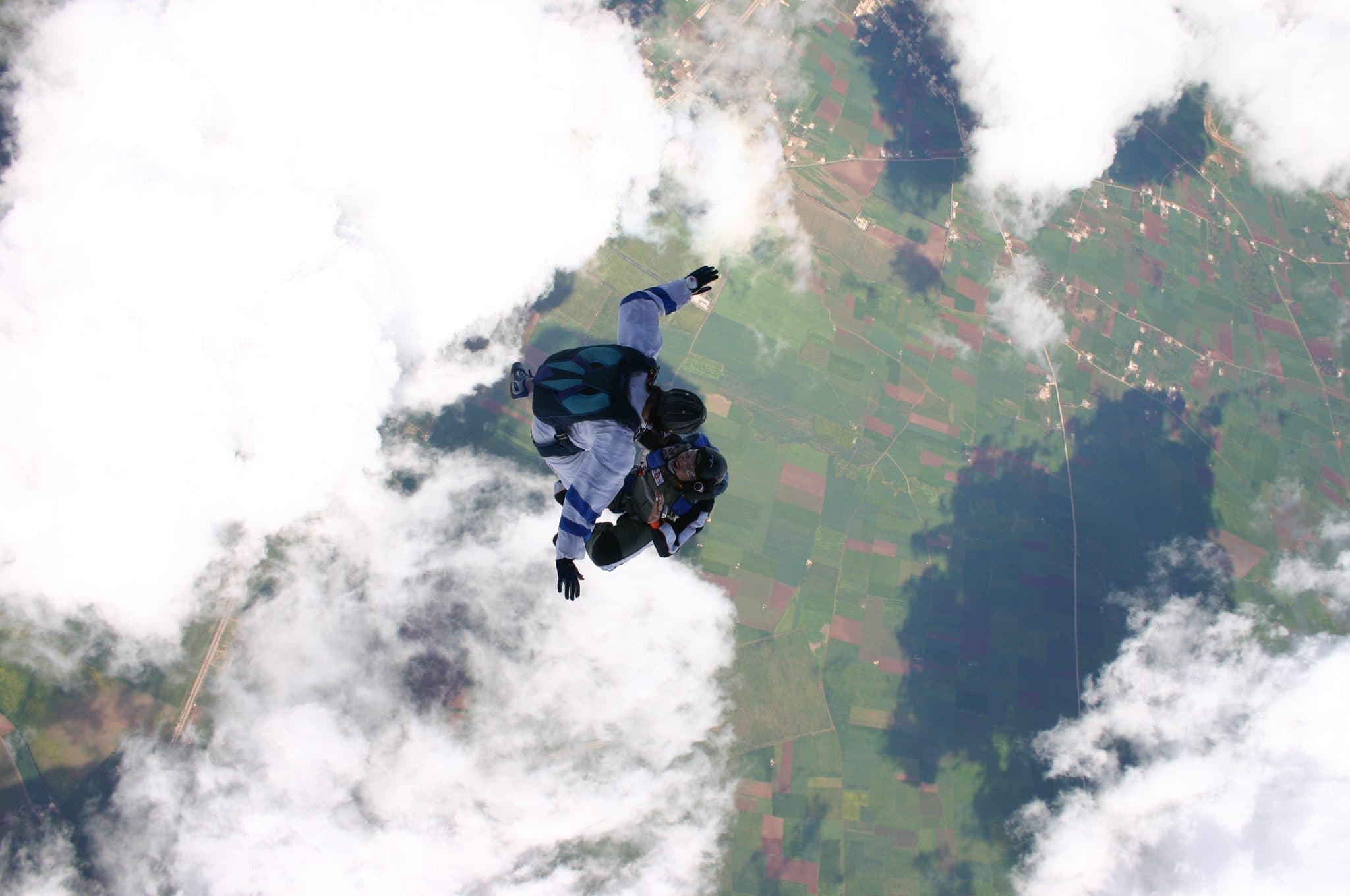
This is the jump of our AFF first jump – and what a jump! Two instructors hold you by the harness on exit. Your mission: hold the position, look at your altimeter, do your practice pulls, then deploy your own parachute at the planned altitude. What we mostly look for: are you "present"? A student who reads their altimeter and can talk through their jump on the ground has passed Level 1.
Common mistakes: holding your breath, tensing your arms, looking at the ground instead of the horizon, forgetting the exit count. Nothing serious: this is the jump of a thousand discoveries, and the debrief helps you put everything in place for the next one.
Level 2: stability
You learn to hold a heading, turn a little and get back to face-to-earth after being deliberately unbalanced: this is the level where you feel your body start to "fly". On the first jumps of this level, the instructor still holds you on exit, then lets you exit on your own. They stay beside you until deployment.
Common mistakes: arms or legs out of symmetry, causing unwanted turns; too much arch, making you back-slide; concentrating so hard on the exercise that you forget your altimeter.
Level 3: the release and independence
The instructor no longer holds you: you fly on your own, under their eye, until deployment. This is the famous release, a moment many students look forward to with a mix of nerves and impatience – and come out of beaming. On the ground, you start kitting up on your own and helping with packing. This is also the level at which you reach the minimum of six accompanied jumps.
Common mistakes: drifting away from the instructor without noticing, losing your heading after a turn, deploying slightly high or low under stress.
Level 4: the solo
The big day: your first jump with no instructor at all in freefall, a memory you never forget. You kit up, board with the other skydivers, exit in the planned order, fly your plan and deploy at the set height. A skydiver holding at least a C licence is on board and checks your kit. The solo completes PAC and opens your road to the A licence, covered in our guide to skydiving licence levels.
What happens if you fail an AFF level?
You repeat it, after a debrief and corrections on the ground, and come back stronger. It is common, especially at Level 2 when stability takes one more jump, and it changes nothing for what follows: every jump makes you progress. A repeat jump is charged on top of the package; building a small margin into your budget and trip lets you approach each level with a free mind.
In practice:
- The debrief: your instructor analyses the jump with you, identifies the cause (position, eyes, breathing, rushing) and suggests one simple correction.
- Ground drills: rehearsing the position to fix the problem before you go up again.
- The repeat jump: you do the level again, sometimes with a lighter goal so you go up full of confidence. Its price is given to you before you book.
Our instructors' tip: keep the fun at the centre. A break, a good debrief and another go the next day often work wonders. If stability is slow to come, a few minutes in a wind tunnel can unlock everything. The cost of these extra jumps is built into our calculation of the full budget to your licence.
What a 7-level AFF course covers
A 7-level course usually covers: discovery (Level 1), leg awareness and movement (2), the release (3), 90° then 360° turns (4 and 5), tracking and varied exits (6) and a final consolidation jump (7). In the UK, an 8th level adds a low-altitude exit before consolidation. The exact content varies between schools.
To decide where to train, at home or abroad, see our guide to doing your AFF course abroad in winter. And if you are still torn between a tandem and an AFF first jump, our guide tandem vs AFF for your first skydive helps you find the option that suits you.
At PACMA: AFF first jump (€500) then the 7-jump AFF course (€1,300)
Here in Beni Mellal… PACMA is a club approved by the French Parachuting Federation (FFP), founded in 2000 and in Beni Mellal since 2003: our training follows the PAC progression and the FFP's rules. Every jump leaves from around 4,000 m in our Pilatus PC-6 Porter: close to 50 seconds of freefall to learn in, every time. You deploy yourself at around 1,500 m, then fly your canopy for 5 to 7 minutes facing the Atlas to landing, and every jump ends with a debrief with your instructor.
| Option | Equivalent to | Non-residents | Moroccan residents | Group (10+ people) |
|---|---|---|---|---|
| AFF first jump | Ground school + Level 1, with 2 instructors | €500 | 5,500 MAD | 5,000 MAD |
| AFF course | Ground school + 7 supervised jumps, Level 1 to solo | €1,300 | 14,200 MAD | 13,200 MAD |
The AFF first jump is Level 1 on its own: the ideal way to taste freefall as a student before diving into the course. Our AFF course in Morocco takes you from Level 1 all the way to your solo, with one or two instructors in freefall depending on the level. For both, an FFP-approved medical less than three months old is required; without one, the club doctor can examine you on site (200 MAD). The federation licence and insurance are taken out on site.
The 2026-27 season runs from 1 December 2026 to 31 March 2027, every day from 8:30 am to 6 pm, and a jump cancelled for weather is rebooked free of charge. Your Level 1 is waiting above the Tadla plain, facing the snow-capped Atlas, in the winter sun: book your AFF first jump and live your first student freefall. After your solo, the next steps are covered in what to do after AFF.