Choosing a skydiving centre well is how you guarantee yourself a jump you can enjoy with a clear mind. It takes just three checks: who looks after you (qualified instructors, affiliation to a federation), what you jump with (equipment, aircraft, maintenance) and on what terms (full price, weather policy, written requirements). Price and photos come second. Below is the 12-point scoring grid our instructors would use to choose a centre for someone close to them, the red flags to watch for, the questions to ask before you pay and a final checklist that works for any centre: in ten minutes, you'll know how to book with complete confidence.
The short answer. A good centre states its federation and its instructors' ratings, fits an AAD to every parachute, publishes a full price, its requirements (weight, age, health) and a written weather policy. Ask your questions in writing before you pay: how clearly they answer is the best clue, and a good centre will be happy to reply.
How do you choose a skydiving centre? 12 criteria
By checking three families of criteria: supervision (federation, instructor ratings, track record), equipment (an AAD on every parachute, an in-date reserve repack, an aircraft built for jump flying) and terms (full price, weather policy, written requirements). Reviews, welcome and the briefing language complete the picture, and they often make the difference between a good jump and an unforgettable memory.
Score each criterion from 0 to 2 (0 = missing or vague, 1 = partial, 2 = clear and verifiable). Score above 18 out of 24 and you are dealing with a transparent centre.
| # | Criterion | What to check |
|---|---|---|
| 1 | Track record and experience | How long the centre has been running, at which airfield, with which team |
| 2 | Federation affiliation | Standards stated: FFP in France, USPA, British Skydiving… |
| 3 | Instructor ratings | Current tandem or AFF instructor ratings |
| 4 | Safety equipment | Automatic activation device (AAD) on every rig, reserve repack in date |
| 5 | Aircraft and pilots | Aircraft type, maintenance, pilots experienced in jump flying |
| 6 | Price transparency | Full price shown, options and surcharges spelled out |
| 7 | Weather policy | Free rebooking or credit in writing, notice period |
| 8 | Written requirements | Weight, age, medical certificate published before you book |
| 9 | Online reviews | Volume, how far back they go, the centre's replies |
| 10 | Insurance and membership | What is included, what you take out on site |
| 11 | Welcome and organisation | Time on site, briefing, friends and family |
| 12 | Language | Briefing in a language you fully understand |
1 to 3: who looks after you
Track record isn't everything on its own, but a centre that has been operating from the same airfield for years has well-oiled procedures and knows its local weather inside out.
Federation affiliation is the best objective filter. In France, look for a centre affiliated to the French Parachuting Federation. In the United States, the USPA keeps a directory of member dropzones, which commit to its Basic Safety Requirements. Outside these countries, ask which standards are applied.
Instructors must hold a current tandem rating (or AFF rating for training) issued by a federation. Don't hesitate to ask about their experience: a serious centre will answer gladly, and often with pride.
4 and 5: what you jump with
Every rig should carry an automatic activation device (AAD), which deploys the reserve automatically if the main parachute is still not open at a critical altitude. The reserve parachute must be packed by a qualified rigger within the regulatory interval: at least once a year in France, every 180 days in the United States. To understand how the canopy, reserve and deployment work, read our article on how a parachute works.
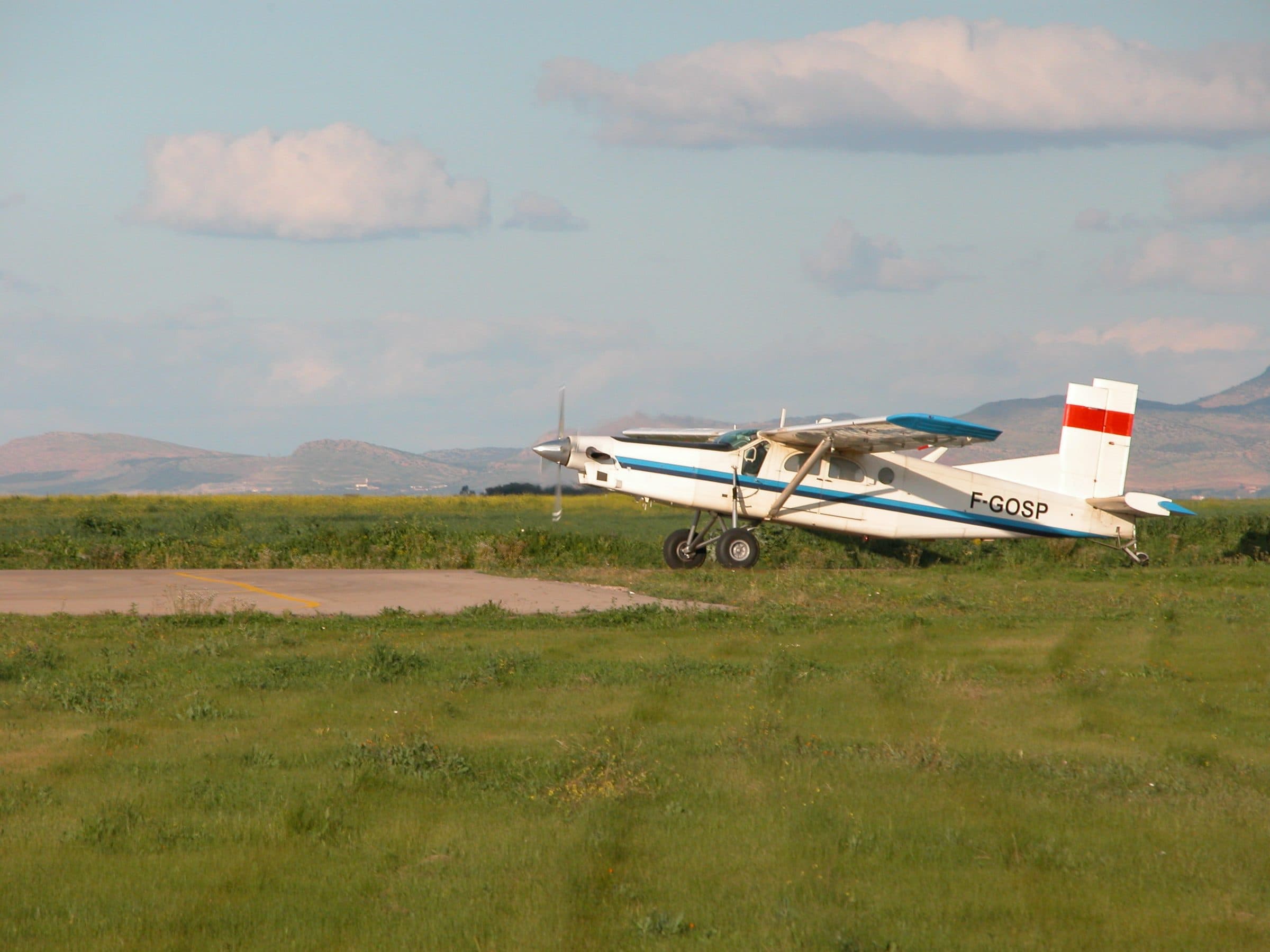
The aircraft matters too, and it's part of the fun. A purpose-built jump aircraft (Pilatus PC-6, Twin Otter, Cessna Caravan…) climbs quickly and has a wide door, ideal for a comfortable exit. Ask who maintains it and whether the pilots specialise in dropping skydivers.
6 to 8: on what terms
The price should be complete: jump, video, any licence or insurance, booking fees and possible surcharges (weight, weekends, altitude). To see how prices compare around the world, read our skydiving price comparison.
The weather policy should be in writing before you pay. The right standard: free rebooking or a credit, so a windy day never costs you your jump.
The requirements (maximum weight, age, medical) should be published. When they are clearly displayed, you arrive on the day relaxed, with no surprises at all.
9 to 12: the customer experience
Read reviews methodically (see the FAQ). For insurance, know what is included and what you take out on site. For organisation, bear in mind that a tandem often takes half a day, sometimes more. And the briefing language matters a lot: understanding every instruction, especially for the landing, is what lets you relax and enjoy it to the full.
What are the red flags at a skydiving centre?
A very low price with no breakdown, no mention of a federation or equipment, vague answers about AADs, no questions about your weight or health, pressure to jump despite the weather or to pay immediately. One flag on its own does not condemn a centre; two or three should send you looking elsewhere.
- A price well below the local going rate, with no breakdown of what is included.
- No mention of a federation, instructor ratings or equipment on the website.
- Evasive answers when you ask whether every rig has an AAD.
- No questions about your weight, age or health before the jump.
- Pressure to jump despite wind, rain or low cloud, or to pay immediately.
- Reviews that are all perfect, all recent and all written in the same style.
- A middleman who won't tell you the name of the centre where you'll jump.
- A vague altitude ("up to 4,000 m") with no indication of the actual exit height.
A single red flag doesn't condemn a centre, but from two or three onwards, look elsewhere. For real risk figures and how the safety systems work, read our article Is skydiving dangerous?
Questions to ask before you book
Copy this list and send it by email or message. The quality of the replies speaks volumes, and a transparent centre will gladly answer point by point.
- Which federation are you affiliated to, or which standards do you follow?
- Are your tandem instructors rated, and how long have they been jumping?
- Does every rig have an AAD?
- Which aircraft do you use, and what is your actual exit altitude?
- How long is the freefall?
- Is everything included in the price? What extras could be added?
- Can video be added after the jump?
- What happens if the weather prevents the jump?
- What are the maximum weight, minimum age and medical certificate requirements?
- How much time should I allow on site?
- What language is the briefing given in?
Gift experience boxes and resellers: benefits and risks
Gift experience boxes and resale platforms are convenient: you buy in a few clicks, the presentation is polished and the recipient gets to choose. They do, however, add a middleman between you and the centre, which is worth bearing in mind before you give one.
| Gift box or reseller | Booking direct | |
|---|---|---|
| Choice of centre | From a list, sometimes assigned | Your choice |
| Price | Fixed, sometimes with surcharges on the day | The centre's public price |
| Validity | Usually 1 year to 18 months, according to French consumer group Que Choisir | Set by the centre |
| Availability | Slots sometimes limited for box holders | Full calendar |
| Who to contact if there's a problem | The reseller, then the centre | The centre directly |
| Weather cancellations | Two sets of terms (reseller and centre) | One set of terms |
For comparison, at PACMA a gift voucher bought direct today is valid for the 2026-2027 season, until 31 March 2027, and the exact date is printed on the voucher. You can print it instantly: perfect for a last-minute present that makes a big impression.
Our advice: before buying a gift box, check the list of partner centres, the actual jump altitude, the expiry date and extension terms, and any surcharges (video, weight, weekends). If you already know where the recipient will jump, a gift voucher bought directly from the centre is often the simplest choice: one contact, one payment, and the centre's public price. In France, if you have a dispute with a gift box provider, start by trying to settle it amicably; if that fails, you can report the situation on SignalConso, the French government's consumer reporting site.
The neutral checklist before you pay
Whichever centre you choose, ours included, you should be able to tick every one of these boxes before paying for your jump:
- The centre states its federation or the standards it follows, and its instructors are rated.
- Every rig has an AAD and a reserve packed within the required interval.
- The aircraft is built for jump flying and the actual exit altitude is stated.
- The full price is shown, options and surcharges included.
- The weather policy (rebooking or credit) is in writing.
- The requirements (weight, age, medical certificate) are published before you book.
- You know how much time to allow on site and in which language the briefing will be given.
- Your written questions received clear, precise answers.
If a box stays unticked, simply ask the question before you pay: you'll then approach jump day with just one thing on your mind, enjoying it.
Where can you check all this for PACMA?
Apply the same grid to PACMA, without taking our word for it: we publish everything, gladly. The club's story (founded in 2000, in Beni Mellal since 2003, FFP-approved) and team are on the club page, supervision and equipment on our safety at PACMA page, the jump and its requirements (90 kg maximum dressed, medical certificate) on the tandem page, and the full price list on the prices page. For the real numbers behind the risk, read is skydiving safe? too.
Made your choice? Book your tandem online and treat yourself to around 50 seconds of freefall in the winter sun, facing the Atlas: €250 (2,500 MAD for Moroccan residents), exit at about 4,000 m from a Pilatus PC-6, free rebooking if the weather is against us, every day from 1 December 2026 to 31 March 2027. To plan your trip, our guide to skydiving in Morocco brings together all the practical information.