Skydiving weather conditions are the number one factor in whether a jump goes ahead, and the good news is that the recipe for a great jumping sky is simple: moderate wind on the ground, enough gaps in the cloud to see the ground from the aircraft, and no rain. Here is how our instructors read the sky, who makes the call, the best time of day and of year for beautiful conditions, and why, with us, a jump delayed by the weather is never a jump lost.
In short. You jump with moderate ground wind (7 m/s at most for a student under French Parachuting Federation rules), a sky that lets you see the ground, and no rain or storms. Cold is not a problem: a cold, dry winter sky is often stunning. The chief instructor makes the call. At PACMA, a jump cancelled because of the weather is moved free of charge to another date in the season or, failing that, turned into a voucher valid for the following season, so you can book with total peace of mind.
What weather do you need to skydive?
Moderate ground wind without strong gusts, a sky clear enough to see the ground from the aircraft, no rain and no storms nearby. For students, the French Parachuting Federation (FFP) limits ground wind to 7 m/s, about 25 km/h. Cold never stops a skydive: just dress for it and enjoy crystal-clear air.
Ground wind
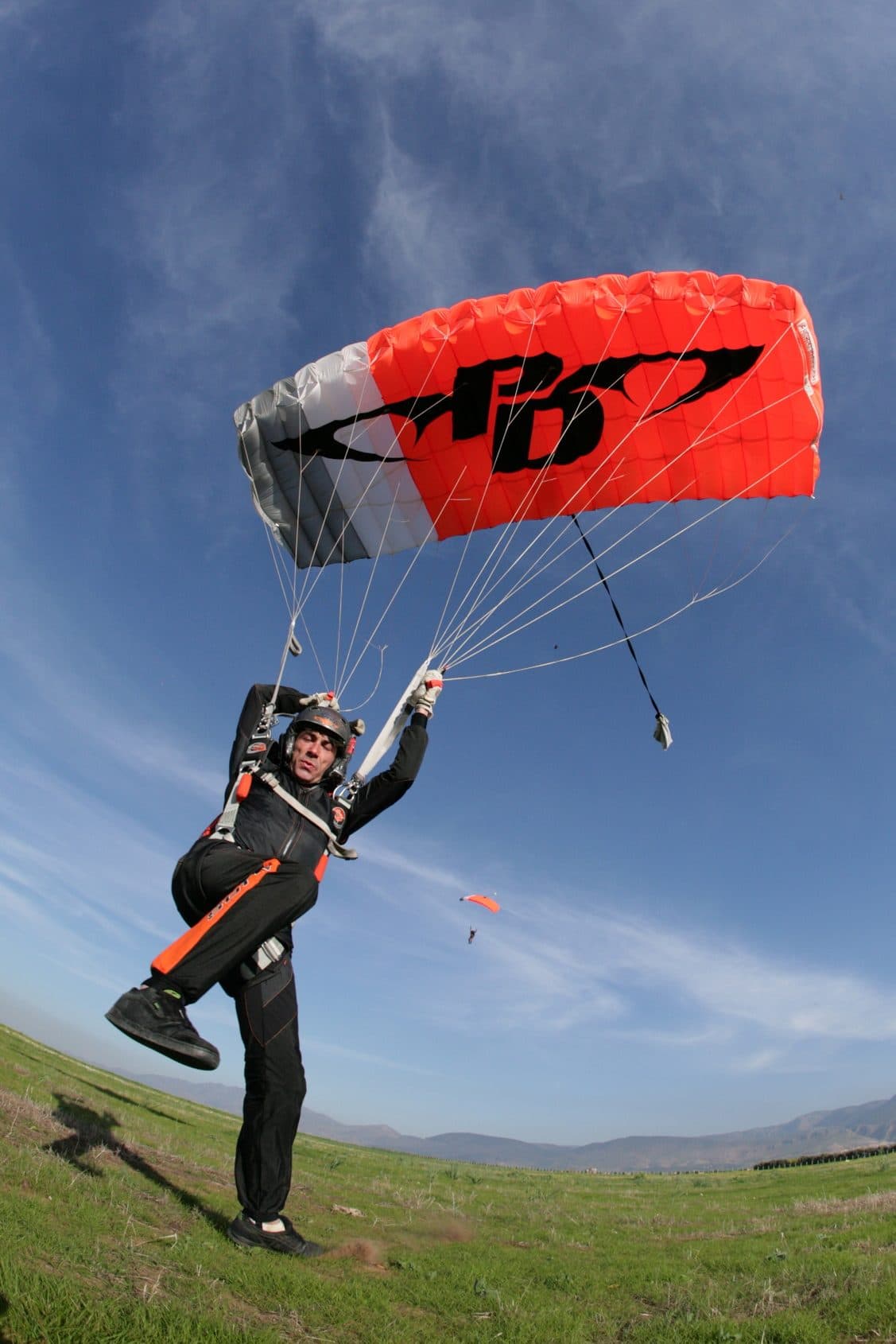
This is the most closely watched factor, because it makes for a soft landing. A parachute canopy flies forward at a few tens of km/h. In moderate wind it touches down gently, into the wind, like a glider; if the ground wind gets too strong, the canopy can no longer make enough headway, which is exactly why instructors set clear limits.
Limits depend on the jumper's level:
| Profile | Ground wind limit (guidelines) |
|---|---|
| PAC (AFF) student, before signing off the canopy module of the A licence | 7 m/s, about 25 km/h (FFP technical directive) |
| Student in the United States | About 14 mph, around 22 km/h, according to the USPA recommendation reported by Skydive Mag |
| Tandem | Set by the equipment manufacturer and the dropzone's technical management |
| Licensed skydiver | Personal limit, depending on experience and canopy |
A tandem can usually handle a little more wind than a student: it's flown by an experienced instructor under a large canopy designed to carry two people smoothly. There's no single figure: every dropzone sets its own rules, and that's what guarantees you a jump in good conditions.
Gusts are what we watch most, more than the average wind speed. A steady 20 km/h wind is more comfortable than 10 km/h gusting to 30. When the gap between average wind and gusts widens, we simply hold the lifts until the air settles.
Wind at altitude
Wind at 4,000 m is often much stronger than on the ground, and it makes no difference to your freefall: you fall with the air mass and feel nothing special. It only shifts the exit point. The pilot and the chief instructor work out where skydivers should leave the aircraft so they can glide comfortably back to the landing area under canopy. In strong winds aloft, that calculation is done more finely and a lift may wait for the right moment.
Cloud and visibility
A skydiver must see the ground before leaving the aircraft and never falls through cloud: that way you always keep sight of the landing area and of other skydivers. US regulations, for example, prohibit jumping into or through cloud and set minimum distances from cloud and visibility of at least 3 miles below 10,000 feet (14 CFR § 105.17).
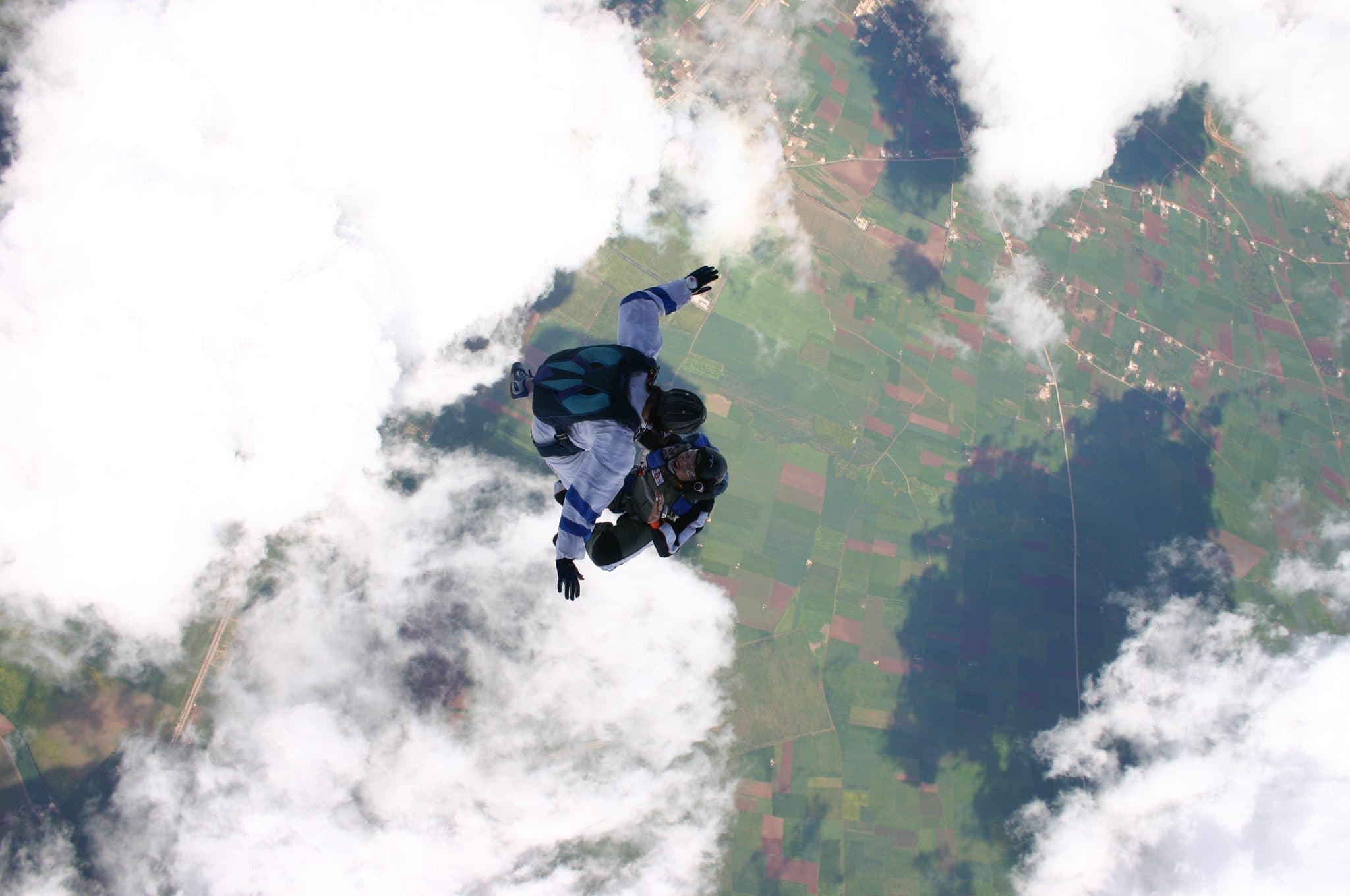
In practice, a partly cloudy sky is great for jumping, and even makes for spectacular footage: the aircraft drops you over a gap. Only a low, continuous cloud base means waiting for it to lift, jumping from a little lower (with less freefall) or rescheduling.
Rain
We always jump in the dry. At 200 km/h, raindrops sting like needles on your face, and rain comes with low cloud and a heavier canopy. The good news: a passing shower usually just delays the lifts by an hour or two, long enough for a coffee once the sun is back.
Storms and turbulence
Cumulonimbus (thunderstorm clouds) are the main danger: violent gusts, updraughts, lightning. As soon as a storm is forecast nearby, everyone stays on the ground, no debate. Thermals, the columns of warm air that rise as the ground heats up, can also make the canopy ride livelier in the middle of the day. For a tandem it mostly feels like a few gentle bumps; for students, we simply pick the calmest slots.
Cold
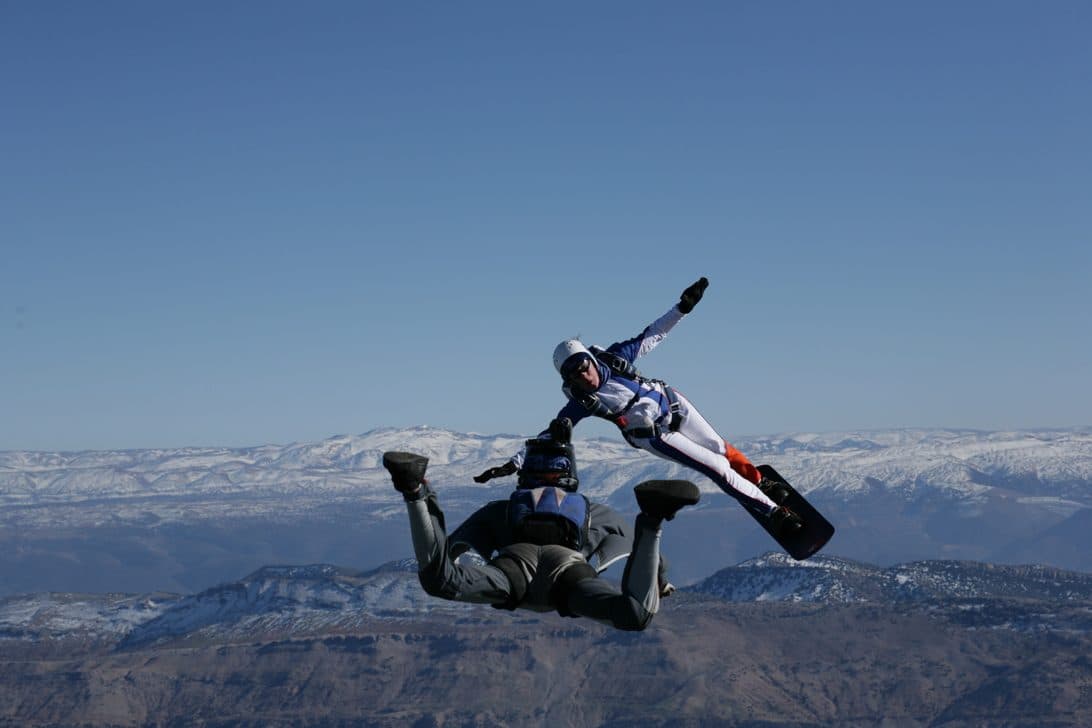
Cold doesn't stop a skydive; quite the opposite. Temperature drops by about 6.5 °C for every 1,000 m in the standard atmosphere: from the Beni Mellal airfield, at around 470 m, it's about 23 °C colder at 4,000 m. In winter, just dress for it (what to wear skydiving) and enjoy a cold, dry sky, often one of the finest skies for jumping, with a sharp view all the way to the snow-capped Atlas peaks.
To understand how a canopy flies and why wind matters so much on landing, read our article on how a parachute works.
Who decides whether you jump, and how?
The chief instructor, or the person in charge of operations they appoint: a professional whose job this is, not the customer and not the pilot alone. They combine the airfield's anemometer and windsock, aviation forecasts and observations, a direct look at the sky and the limits of each profile, then reassess continuously, lift after lift, to make the most of every good window.
Their tools and criteria:
- the dropzone's anemometer and windsock, for ground wind and gusts;
- aviation forecasts and observations (wind aloft, cloud base, storm risk);
- direct observation of the sky and, often, a first lift of experienced skydivers or feedback from the pilot;
- the limits of each profile: a sky can suit licensed jumpers before it suits students.
A windy morning can turn into a perfect afternoon. That's why you're sometimes invited to wait on site: the sky often turns in your favour during the day.
At PACMA, a club approved by the French Parachuting Federation, weather decisions are made by the chief instructor, and the rule is simple: we go up only when every condition is right. That culture is what has made skydiving such a well-supervised, well-controlled activity; for the figures and safety systems, see our article is skydiving dangerous?.
What is the best time of day to skydive?
Often the morning: the air is calm and stable before thermals build. Late afternoon is the other golden slot, with dropping winds and beautiful warm light. The middle of the day can be a little livelier under strong sun. In winter the differences are smaller, because the ground heats up less: the whole day is good for jumping.
- Morning: an excellent slot for students. Morning mist or low cloud can sometimes delay the first lift until it burns off.
- Midday: under strong sun, thermals can make the air more lively near the ground, and breezes can pick up.
- Late afternoon: the wind often drops and the light is sublime. It's the camera flyers' favourite slot, and great for your photos.
Our advice: book a morning slot and keep the rest of the day free. If the weather pushes the lifts back, you can relax in the sun under the tent by the runway, with no pressure at all.
What is the best time of year to skydive?
It depends entirely on the local climate: late spring to early autumn in northern Europe; autumn, winter and spring around the Mediterranean and in inland Morocco; winter in hot deserts. That difference is what lets you skydive all year round if you travel, and turn your winter into freefall season.
| Climate type | Best skydiving season | Why |
|---|---|---|
| Temperate (northern and central Europe) | Late spring to early autumn | Cold, grey winters with short days |
| Mediterranean and inland Morocco | Autumn, winter and spring | Mild, sunny winters, very hot summers |
| Hot desert | Winter | Summers too hot, strong thermals |
| Tropical | Dry season | Stormy rainy season |
To find out where to jump when your home dropzone is closed, and which month to pick, see our month-by-month comparison of winter destinations.
Skydive cancelled due to weather: what happens?
Your jump isn't lost: it's rescheduled. PACMA's policy is clear and in writing: if the weather is unsuitable, your jump is moved free of charge to another date in the season or, failing that, turned into a voucher valid for the following season. So you book with no risk. Elsewhere, rules vary: make a habit of reading them before you pay, especially if you book through a third party.
What you can rightly expect from a good dropzone:
- Your jump is not lost: it's rescheduled.
- Rebooking is free if the cancellation is down to the weather.
- The dropzone lets you know as early as possible, ideally the day before when the forecast is clear.
If you're travelling a long way, build a little slack into your trip: a spare day is often enough to ride out a windy spell, and it's a chance to enjoy a bit more Moroccan sunshine. Practical questions (arrival, times, directions) are covered on our practical information page, with short answers in our FAQ.
Why a Beni Mellal winter suits skydiving so well
Because the Tadla plain stays dry and bright in winter. According to NOAA's 1991–2020 normals, Beni Mellal averages around 5 to 6 rainy days a month from December to March, with afternoons of 18 to 23 °C. The rest of the time the sky is yours: wind and low cloud are the main reasons lifts get delayed.
| Month | Average high | Average low | Rainy days (≥ 1 mm) |
|---|---|---|---|
| December | 19.1 °C | 4.5 °C | 5.8 |
| January | 18.1 °C | 2.9 °C | 5.2 |
| February | 19.5 °C | 4.4 °C | 5.3 |
| March | 22.6 °C | 7.3 °C | 5.5 |
| April | 25.2 °C | 9.9 °C | 4.0 |
What this means for your jump:
- The vast majority of days are dry.
- Mild afternoons of around 18 to 20 °C in midwinter: you wait your turn in a T-shirt in the sun, facing the Atlas.
- Chilly mornings, with nights around 3 to 5 °C: bring a warm layer, especially for the climb to 4,000 m.
Beni Mellal's full normals, a comparison with other cities and today's conditions are on our Beni Mellal weather page.
This climate is what allows the club to open every day from 8:30 am to 6 pm, from 1 December 2026 to 31 March 2027, while most northern European dropzones are closed. Around 50 seconds of freefall from 4,000 m, winter sunshine and the Atlas as your backdrop, for €250: all the details are on our tandem page, and you can book your tandem skydive right now, with peace of mind thanks to free rebooking.