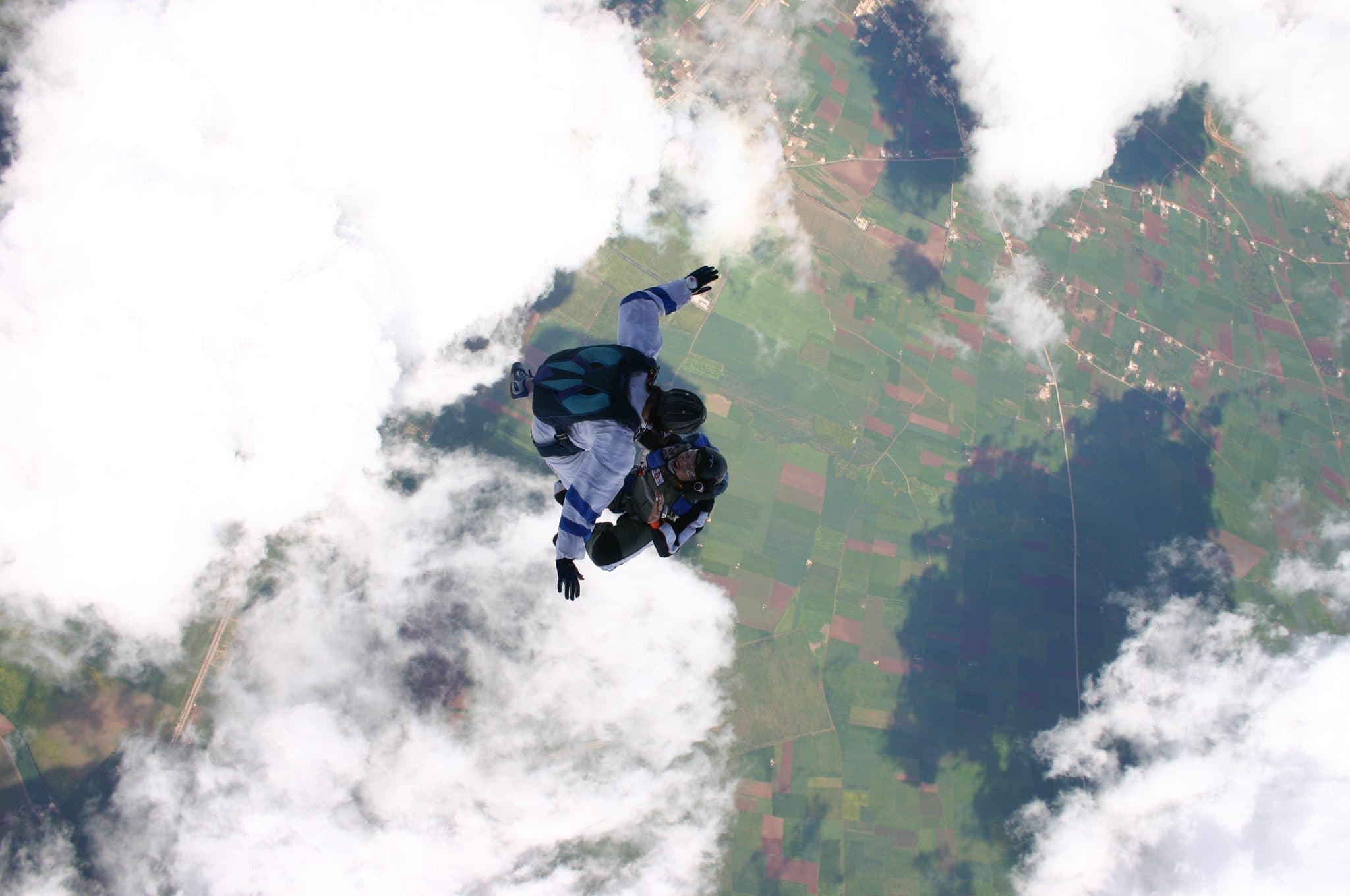
Tandem vs AFF for your first skydive? Good news: there's no wrong choice! A tandem gives you freefall with nothing to learn, for €250; an AFF first jump has you skydiving under your own parachute after ground school, for €500. Both leave the aircraft at around 4,000 m and give you close to 50 seconds of freefall, for two very different adventures. Here is how to choose, using the criteria our instructors use to advise beginners, plus a quiz that tells you in a few clicks which first jump suits you.
Tandem or AFF first jump: what is the difference?
On a tandem you are a passenger, attached to an instructor who handles the exit, deployment, canopy and landing: all you do is enjoy it. On an AFF first jump you are already a student skydiver: you wear your own parachute, two instructors hold you in freefall and you deploy it yourself at around 1,500 m. Same height, same freefall, two ways to live it.
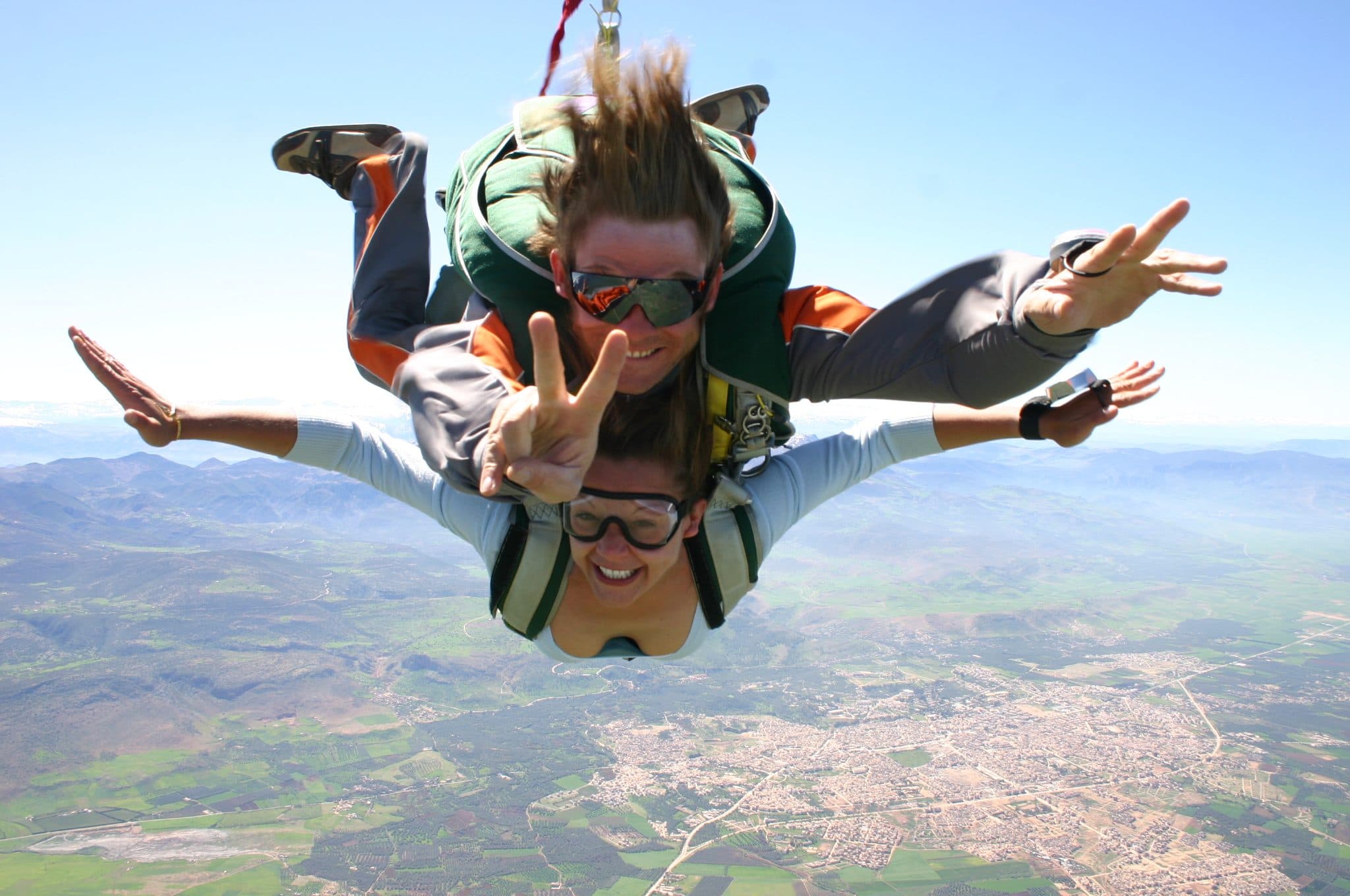
A tandem skydive is a taster. You are harnessed to a qualified instructor wearing a two-person parachute. They handle the aircraft exit, stability, deployment, flying the canopy and the landing. Your only mission: listen to the briefing, adopt the right position and savour every second. To find out exactly how the day goes, from briefing to landing, read our article on what happens on a tandem skydive.
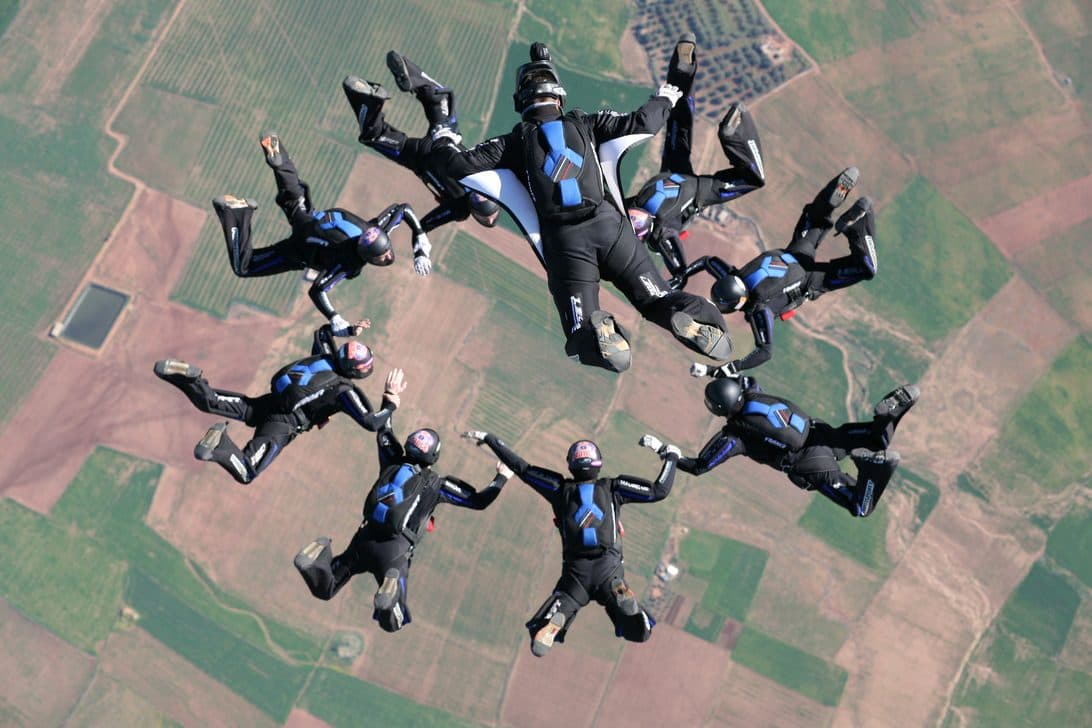
The AFF first jump (PAC in France, short for Progression Accompagnée en Chute, the French equivalent of Accelerated Freefall) is a genuine first jump as a student skydiver. You wear your own parachute. Two instructors jump with you and hold your harness during freefall, but you hold the position, watch your altimeter and pull to deploy. Under canopy, you fly yourself down to the ground.
The difference is real, and it's what gives each option its charm. An AFF first jump gives you proper ground school (equipment, position, deployment, emergency procedures, canopy flight) and the challenge of a jump where you're in the driving seat. A tandem needs just a briefing: you're ready in no time.
Comparison table: training, time, price, sensations, responsibility
Here are both options side by side, at PACMA's official prices for the 2026-27 season, so you can choose at a glance.
| Criterion | Tandem skydive | AFF first jump |
|---|---|---|
| Training | A briefing with your instructor | Full ground school: theory, position, deployment, emergencies, canopy |
| Time to allow on site | Half a day | A full day |
| Exit height (Beni Mellal) | Around 4,000 m | Around 4,000 m |
| Freefall | About 50 seconds | About 50 seconds |
| Instructors | 1, attached to you | 2, holding your harness |
| Who deploys the parachute? | The instructor | You, at around 1,500 m |
| Who flies the canopy? | The instructor | You |
| Landing | With the instructor | On your own, under your own canopy |
| Price, non-residents | €250 | €500 |
| Price, Moroccan residents | 2,500 MAD | 5,500 MAD |
| Video and photos | Optional (€100 / 1,000 MAD) | Ask the club |
| Weight | 90 kg maximum dressed | To be agreed with the club for your build |
| Medical | Medical certificate, or a check on site (200 MAD) | FFP-approved medical less than 3 months old, possible on site |
| Licence and insurance | Nothing for you to arrange | Federation licence and insurance taken out on site |
| What next? | Up to you: another tandem, or move on to AFF | Level 1 of AFF, recorded in your logbook |
Three rows make all the difference.
Sensations. The freefall is the same: same height, same speed (around 200 km/h), same wind on your face. The difference is in your head. On a tandem your attention is completely free to take in the snow-capped Atlas and shout for joy. On AFF your mind focuses on your plan: arched position, altitude checks, the deployment sequence. You leave with immense pride: you opened your own parachute.
Responsibility. On a tandem the instructor makes every decision: you're in complete confidence. On AFF your instructors hold you and can help, and every rig has an AAD; the goal is for you to act yourself. If you love a challenge, it's pure joy; if you'd rather let go, the tandem is made for you.
Price. The AFF first jump costs twice as much as a tandem, and you get real value for it: two instructors in freefall instead of one, full ground school and your own student kit.
Who is a tandem for? Who is the AFF first jump for?
A tandem is for you if you want to enjoy around 50 seconds of freefall from 4,000 m once, with nothing to learn, from €250. The AFF first jump is waiting for you if you dream of flying your own parachute, held by two instructors, and starting your training, for €500. Here is how to decide at a glance.
A tandem is for you if…
- You want to experience freefall once, for the thrill, with no plan to become a skydiver.
- You have half a day to spare, for example during a stay in Casablanca or Marrakech (2 hours and 2 hours 30 by road).
- You feel a little apprehensive and would rather a professional handled everything: that's exactly what a tandem is about. If fear is getting to you, our 9 instructor tips to tame your fear will help you turn it into excitement.
- You want to give an experience to someone who knows nothing about skydiving.
- You want footage: with the video and photos option, your whole freefall is filmed.
All the requirements (age, weight, medical) are on our tandem page.
An AFF first jump is for you if…
- You want to fly yourself, even just once, rather than ride as a passenger.
- You are thinking of learning to skydive and want to test yourself before committing to a full course.
- You enjoy learning and understanding: ground school is part of the fun.
- You have a full day available and are reasonably fit.
- You are comfortable with having precise moves to make on an adrenaline rush.
What if you weigh more than 90 kg?
Tandems at PACMA are limited to 90 kg dressed, because the two-person parachute has to carry the combined weight of instructor and passenger. A good lead: an AFF first jump can sometimes be an alternative, since you wear a parachute sized for you. The chief instructor decides, based on your build and the kit available: contact the club before booking and they will be happy to look at your case.
Can you skydive alone the first time?
Almost – and that's already a thrill! On an AFF first jump you skydive under your own parachute and deploy it yourself, with two instructors holding you throughout freefall. A true solo, with no instructor beside you, comes next: the FFP requires at least 6 accompanied jumps before that first jump alone.
It is the question the keenest beginners ask us most, and we love that enthusiasm! At a serious school nobody really jumps alone the first time, and that is a good thing: AFF levels take you step by step from "held by two instructors" to "alone in the sky", with complete confidence. What each level involves is explained in our guide to AFF levels.
Does the AFF first jump count towards the course?
The AFF first jump is Level 1 of the PAC progression, and your instructors record it in your logbook: your skydiving adventure is under way. Keen to carry on at PACMA? When you book your course, the club tells you how that first jump is taken into account.
The full AFF course at PACMA includes ground school and 7 supervised jumps from around 4,000 m, from Level 1 all the way to your solo, for €1,300 (non-residents) or 14,200 MAD (Moroccan residents).
A tandem, on the other hand, does not count towards training, since the instructor flies. But it's a superb way in: many skydivers discovered the sport through a tandem before signing up for AFF. For an overview of the whole journey, our guide on how to learn to skydive covers every step.
Here in Beni Mellal… Our instructors often ask people who are torn the same question: "Six months from now, what would you like to be telling people?" If the answer is "I jumped out of a plane at 4,000 m above the Atlas", a tandem is plenty. If it is "I opened my own parachute", go for the AFF first jump. Either way, you'll live an unforgettable moment. PACMA, founded in 2000 and approved by the French Parachuting Federation (FFP), jumps every day of the winter season, from 1 December 2026 to 31 March 2027, from 8:30 am to 6 pm, with free rebooking if the weather is unsuitable.
Quiz: which first skydive is right for you?
Five questions, thirty seconds: the quiz points you to the option that suits you, at this season's official price.