Indoor skydiving vs real skydiving: what if you didn't have to choose? A wind tunnel (or "freefall simulator") gives you a taste of flying on a cushion of air, in town, all year round, from around £50 for two flights. A real skydive gives you the full adventure: the climb, the open door at 4,000 m, about 50 seconds of freefall facing the landscape, then 5 to 7 minutes of canopy flight. Here is our instructors' honest comparison, and the best way to combine the two.
What is indoor skydiving?
Indoor skydiving happens in a vertical wind tunnel: a glass column where powerful fans push air upwards. When the air speed matches your weight, you float, exactly like a skydiver falling belly-to-earth at around 200 km/h. A first-timer session usually takes an hour to an hour and a half on site, for two short, intense flights.
Modern tunnels adjust the airflow across a wide range: Madrid Fly, for example, quotes wind speeds of 180 to 300 km/h depending on the flyer's level (Time Out Madrid). So the tunnel recreates the same relative wind as freefall, on the spot.
A first-timer session always follows the same script: a ground briefing with an instructor (body position, hand signals), kitting up (flight suit, helmet, goggles, earplugs), then two short flights, usually around a minute each, while the instructor holds you and fine-tunes your position.
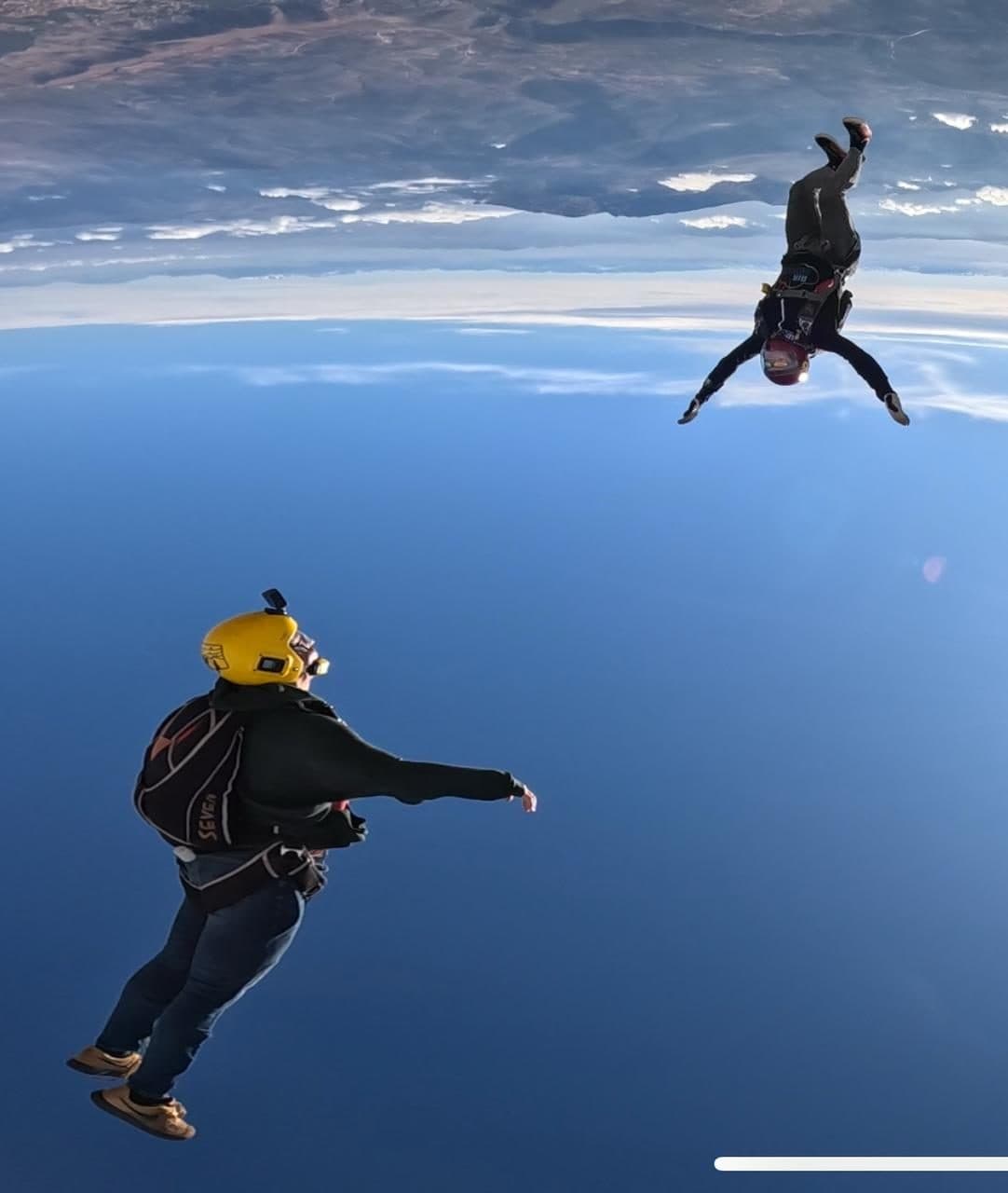
Tunnel flying has become a sport in its own right, with competitions and passionate flyers. For most people, it's a wonderful first taste of flight, easy to reach in town all year round, and often the spark that makes them crave the real sky.
Indoor vs real skydiving: comparison table
| Criterion | Wind tunnel (first-timer flight) | Tandem skydive |
|---|---|---|
| Where? | In town, indoors | At an airfield, in open sky |
| Flight time | About 2 × 1 minute | About 50 s of freefall + 5 to 7 min under canopy |
| Time on site | 1 to 1.5 hours | Half a day |
| Altitude | A few metres | Exit at around 4,000 m |
| Aircraft and open door | No | Yes (Pilatus PC-6 Porter at PACMA) |
| Sense of speed | Strong wind, on the spot | Acceleration on exit, then around 200 km/h of relative wind |
| View | The tunnel walls | The Atlas, the plain, the horizon |
| Parachute | None | Deployment at around 1,500 m, canopy flight |
| Weather | Irrelevant | Depends on wind and cloud (free rebooking at PACMA) |
| Typical price | Around €50 to €70 for 2 flights (see below) | €250 (2,500 MAD for Moroccan residents) at PACMA |
| Age | Often from 3 depending on the centre | Minimum age set by the centre |
| Weight | Limits often wider | 90 kg maximum dressed at PACMA |
Public prices seen in October 2026 for a first tunnel flight: £49.99 for two flights at iFLY UK (plus a £3 booking fee, checked on 18 October 2026), €69.99 for a first flight in two sessions at Madrid Fly according to Time Out, and from €69.90 at iFLY Paris according to Familin'Paris. Prices vary by day and extras (photos, video, "high" flights). To compare skydiving prices around the world, see our article on skydiving prices.
What the table shows: a tunnel gives you pure flying time at a small price, ideal for learning a body position; iFLY even describes its two first-timer flights as equivalent to the freefall time of three skydives. A tandem gives you the whole experience, from take-off to landing, with the Atlas as your backdrop. Two different pleasures, and it's the second one you'll be telling stories about for the rest of your life.
Is indoor skydiving like real skydiving?
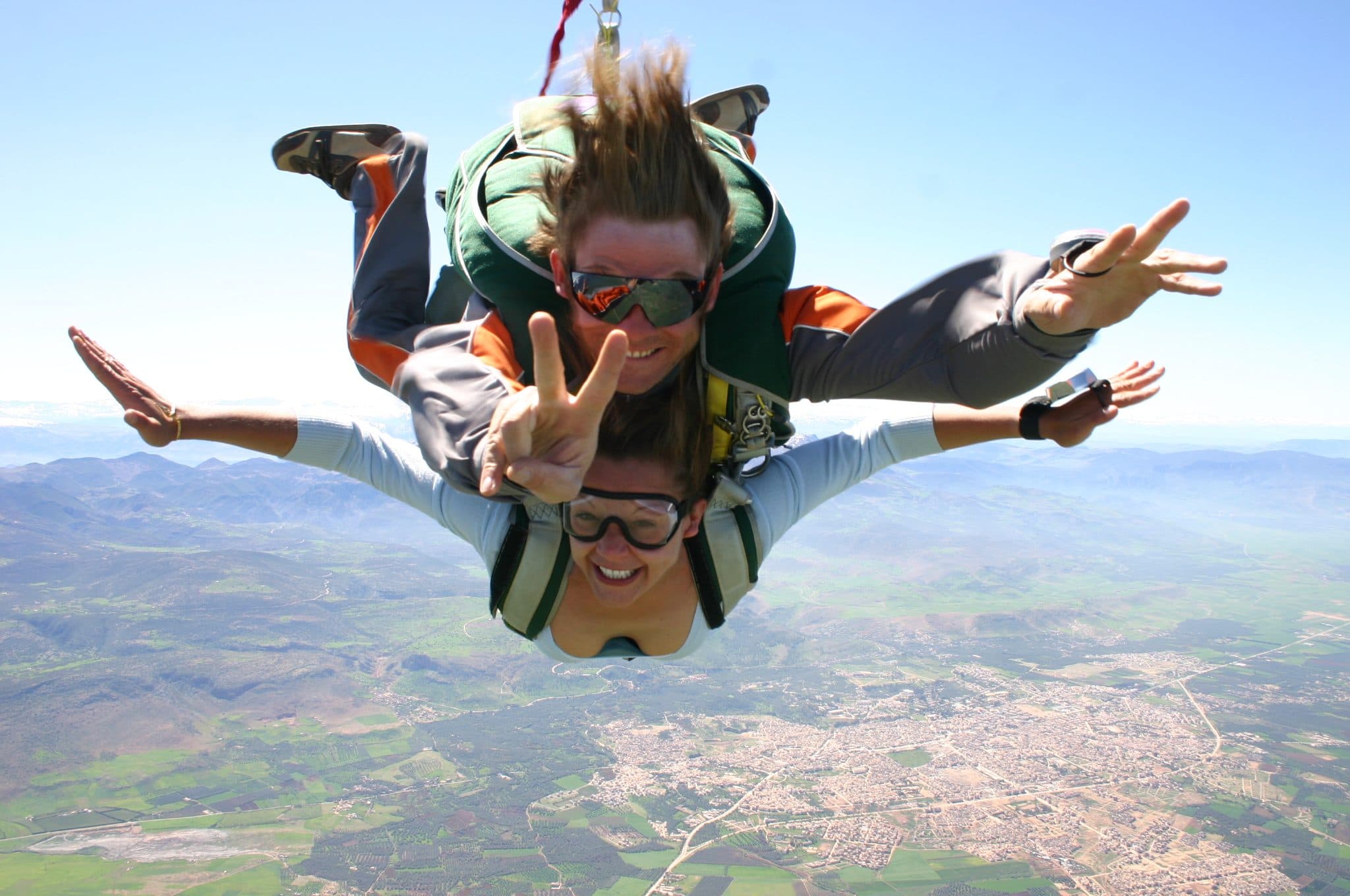
It gives you a foretaste. The relative wind and the floating sensation are close to stable freefall. A real skydive adds the aircraft, the open door at 4,000 m, the acceleration on exit, a view stretching for miles and the parachute opening: that's where the big thrill is born, the one people still talk about years later.
For a skydiving instructor, the tunnel is a superb training tool, and the skydive remains the complete experience. Here is what the sky gives you on top.
The aircraft and the door. The 15- to 20-minute climb, the altimeter winding up, the door opening onto the sky at 4,000 m: this is often the most intense moment of the day, and a memory only skydiving can give you.
The exit. When you leave the aircraft, you accelerate for around ten seconds before reaching terminal velocity. That build-up of speed is the rush that belongs to a real jump; in a tunnel, the air supports you from the first second.
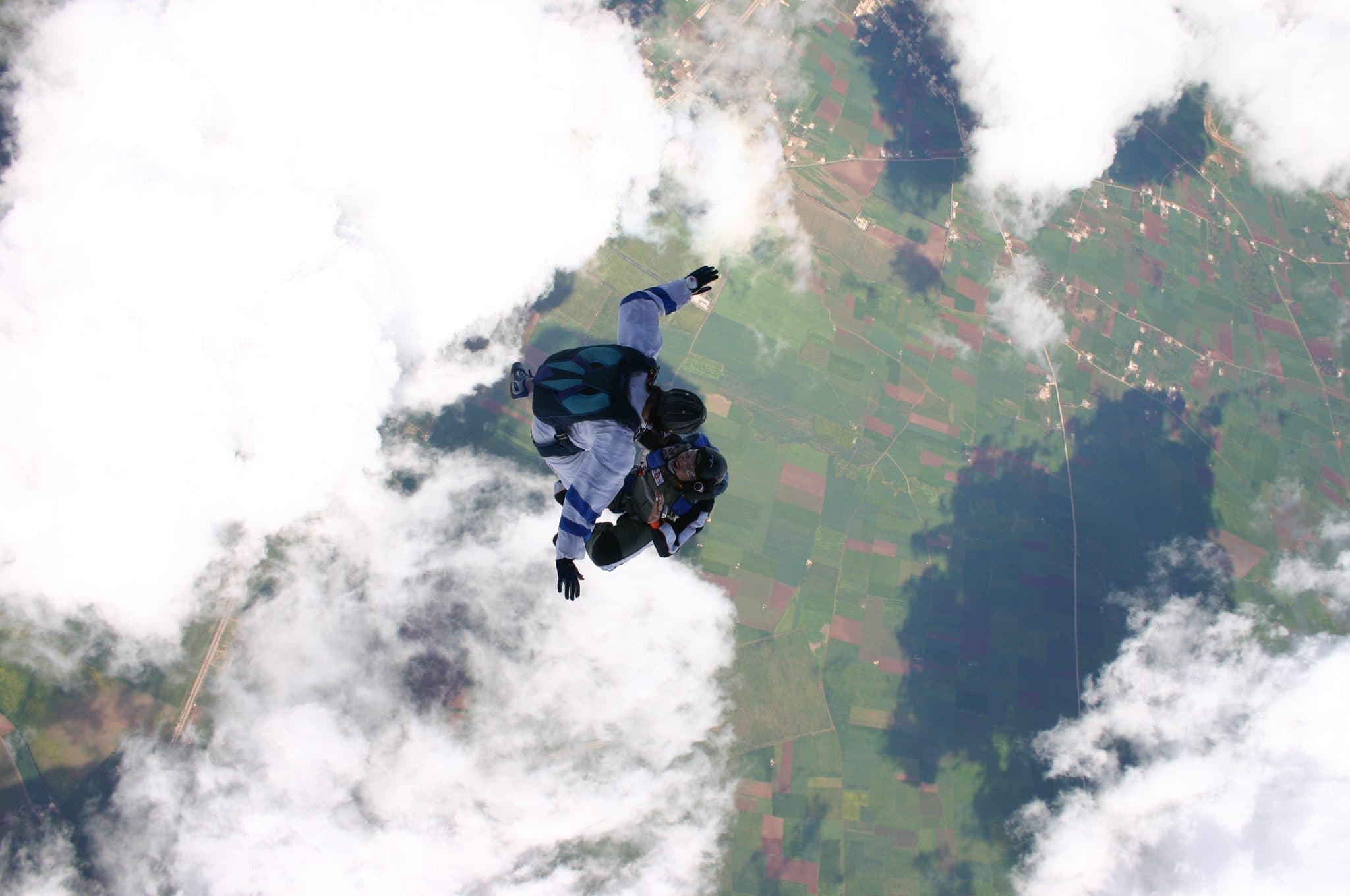
The view and the altitude. In freefall above Beni Mellal you see the Tadla plain, the often snow-capped peaks of the Middle Atlas and a horizon dozens of kilometres away. A winter panorama you won't forget. For a close-up of what it feels like up there, read our article on what freefall feels like.
Deployment and canopy flight. The slowdown as the canopy opens, then the sudden silence and 5 to 7 minutes of peaceful canopy flight are part of the magic of the jump. For a future student, it's also what only the sky can teach: deployment, emergency procedures and canopy control are learned in training, at the airfield.
Managing time and altitude. In a tunnel, the instructor signals when your flight is over. In freefall, the altimeter sets the rhythm of the jump, and that's exactly what training teaches you to master.
Should you do tunnel time before AFF?
It is not compulsory: an AFF course starts from scratch, ground school included, and is designed for people who have never flown. But if a tunnel is within reach, it's an excellent investment: a few minutes to stabilise your body position leave you more headspace on your first jumps and put every chance on your side to pass each level first time.
If you are considering an AFF first jump or an AFF course, the tunnel really comes into its own. It lets you work, more cheaply, on what takes up much of your first jumps: a stable position (hips forward, back arched, arms and legs symmetrical), relaxing in the airflow and reading your instructors' signals.
Why does it help so much? Because on AFF every jump counts and gives you just under a minute of freefall. Arriving with a stable position already frees up all your attention for the jump plan (altitude checks, the deployment sequence), so each jump moves you further forward.
Our instructors' tips:
- A few flights are enough. Two to four minutes of coached flying focused on the belly position give you excellent reference points. No need to aim for tricks.
- Say you are preparing for AFF. The tunnel instructor will adapt the session: neutral position, height control, stability without being held.
- Do it shortly before. The feel stays fresh: a few days or weeks before your course is ideal.
- Keep ground school. Even with hours of tunnel time, the AFF course stays complete: deployment, emergency procedures and canopy flight are learned with our instructors, on the airfield.
To choose between a tandem and an AFF first jump, our comparison of tandem vs AFF for your first skydive will help you decide. The full route to becoming a skydiver is set out in our guide on how to learn to skydive.
How do you combine the tunnel and a real skydive?
The tunnel and a real skydive make a great team. The tunnel trains your position, all year round and in town; the skydive brings the aircraft, the altitude, the view and the parachute. Here are three winning ways to combine them.
1. Tunnel first, tandem second. A little nervous? A tunnel flight near home lets you discover the feel of the air and the position, gently. On the day of your tandem skydive, freefall will already feel familiar, and you'll enjoy it even more.
2. Tandem first, tunnel second. Loved your jump and want to recapture the feeling between trips? The tunnel is the easiest way to fly again, all year round, in town, while you wait for the next season in the sun.
3. Tunnel before your AFF course. This is the ideal combination to progress fast: a few minutes in the tunnel for your position, then the course for everything else.
A word on weight limits: they are often wider in a tunnel than for a tandem. If you are over the tandem limit, our article on skydiving weight limits explains why and what the alternatives are.
Here in Beni Mellal… No tunnel here: you fly in open sky. PACMA, founded in 2000 and approved by the French Parachuting Federation (FFP), drops its skydivers from around 4,000 m from a Pilatus PC-6 Porter, above the Tadla plain and facing the Atlas. Our advice to beginners: if there's a tunnel on your way, make the most of it; if not, come straight to us, because our ground school is built for people who have never flown.
Ready for real freefall? A tandem costs €250 (2,500 MAD for Moroccan residents), every day from 1 December 2026 to 31 March 2027, in the winter sunshine, with free rebooking whenever the weather calls for it. Your seat facing the Atlas is waiting: book your tandem online.