What does skydiving feel like? It's the best surprise of your first jump: you don't feel like you're falling – it feels like flying! Held up by a powerful wind, amid a joyful roar, you soar above a vast, motionless landscape. No stomach in your throat, no gasping for air: just about 50 seconds of pure intensity. Here, moment by moment, is what a tandem skydive from 4,000 m really feels like, the simple explanation behind each sensation, and our instructors' answer to the question everyone asks: is it worth it? (Clue: yes.)
At a glance: the sensations in 5 points
- The exit: a big rush of air that holds you up straight away – no stomach drop.
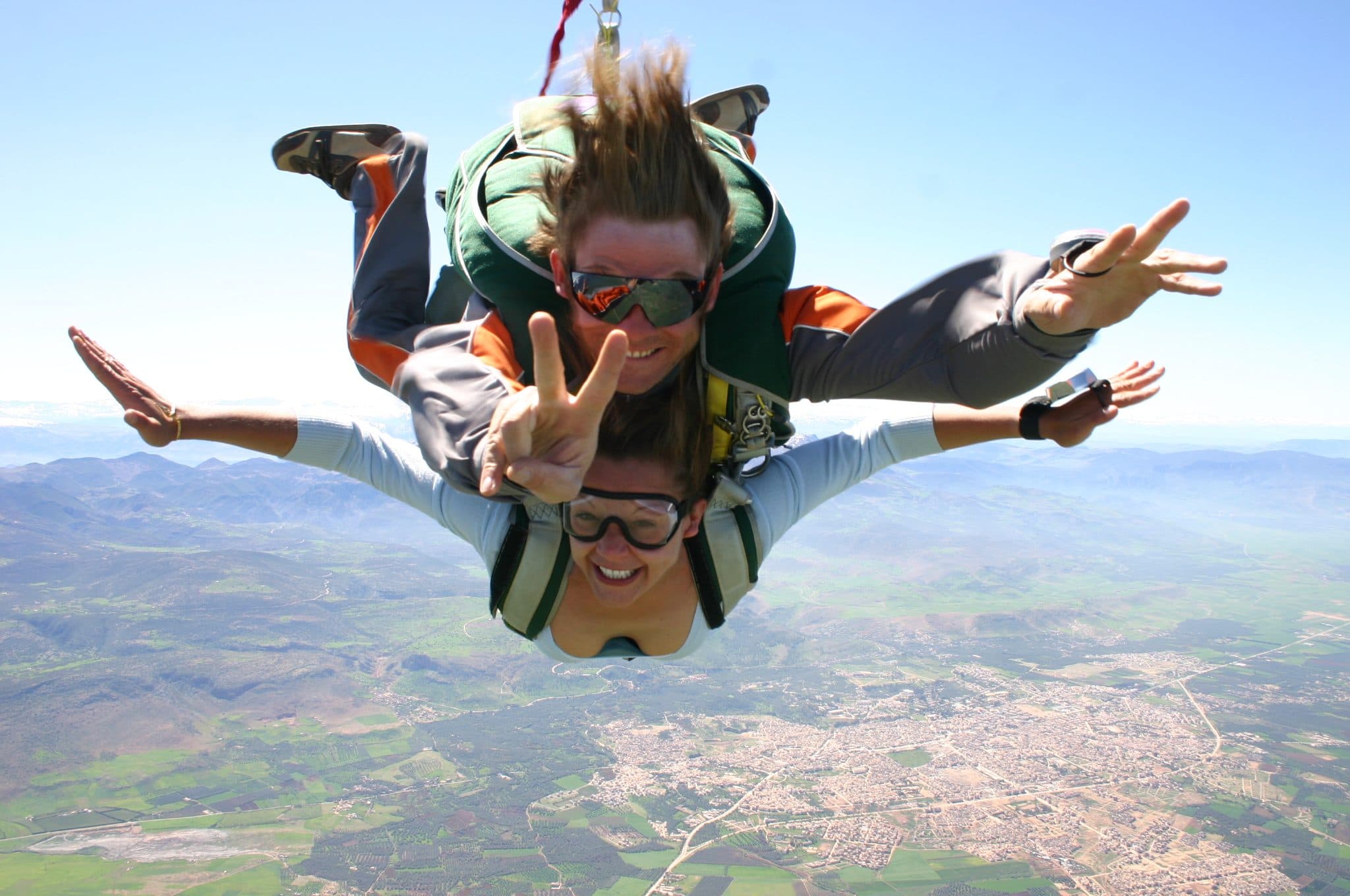
- Freefall: about 50 seconds of powerful wind and a joyful roar – it feels like flying, not falling.
- Breathing: completely natural; one big whoop as you leave and you're away.
- The opening: a firm, progressive slowdown over a few seconds, gentle on the body.
- Under canopy: 5 to 7 minutes of magical silence, facing the peaks of the Atlas.
On the plane: excitement, the open door, the wind
The climb – 15 to 20 minutes facing the Atlas – is already a show, before you've even jumped. Excitement rises with the altitude: racing heart, clammy hands, an urge to laugh or to savour it in silence. That's adrenaline getting to work, and it's what will make the memory so vivid. If the nerves are on your mind, our article scared of skydiving? has practical techniques to turn them into energy.
Then the door opens, and three sensations arrive at once:
- Noise: engine and wind fill the cabin. You have to shout or use hand signals.
- Cold air: at 4,000 m the air is much cooler than on the ground. In the standard atmosphere, temperature drops by about 6.5 °C for every 1,000 m. So if it's 18 °C on the runway, it's around −8 °C at exit altitude.
- Wind on your face: as you move towards the door, you feel the airflow created by the aircraft's speed.
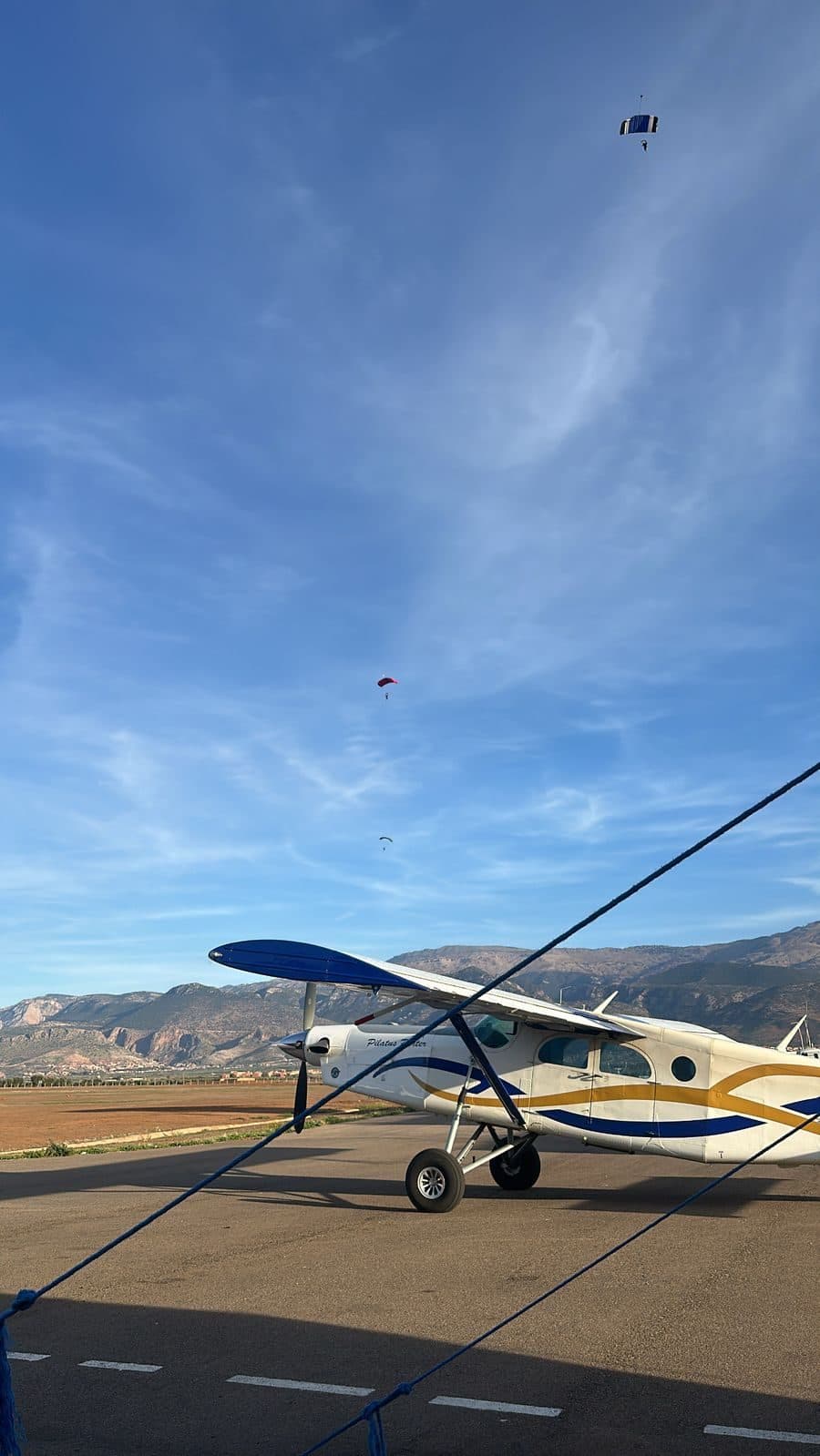
You'll also feel the aircraft getting lighter and shifting slightly as jumpers leave ahead of you: it's the sign your turn is coming, and the Pilatus PC-6 pilot compensates smoothly.
The exit: does skydiving give you a stomach drop? No – here's why
No – and that's the great news: most passengers feel no stomach drop at all, or barely, for a second or two. As you exit, you keep the aircraft's forward speed and the air supports you from the very first second. With no sudden change in acceleration and nothing close by rushing past, there's no rollercoaster effect: you tip straight into the fun.
Even so, it's the most widespread misconception about what skydiving feels like: people expect their stomach to lurch into their throat, as on a rollercoaster plunging downhill or a lift that suddenly drops.
There are two reasons.
1. You don't start from a standstill. When you exit, you're travelling at the aircraft's speed. The relative wind – the airflow holding you up – first blows from the front, then gradually swings round underneath you as you pick up downward speed. There's no sudden break: the air supports you from the very first second. The stomach-lurch of a rollercoaster comes from an abrupt change in acceleration, and that abrupt change barely exists when you leave an aircraft.
2. There's no nearby reference point. On a fairground ride, you see the track and the ground rushing past close by, and your brain reads that as falling. At 4,000 m, the ground is so far away it seems to stand still. With nothing moving past you, your brain doesn't "see" that you're falling.
The result: most passengers describe the exit as a big rush of air, a tip forward, then a surprising stability. A take-off, not a fall.
Freefall: noise, wind, pressure, cold and breathing
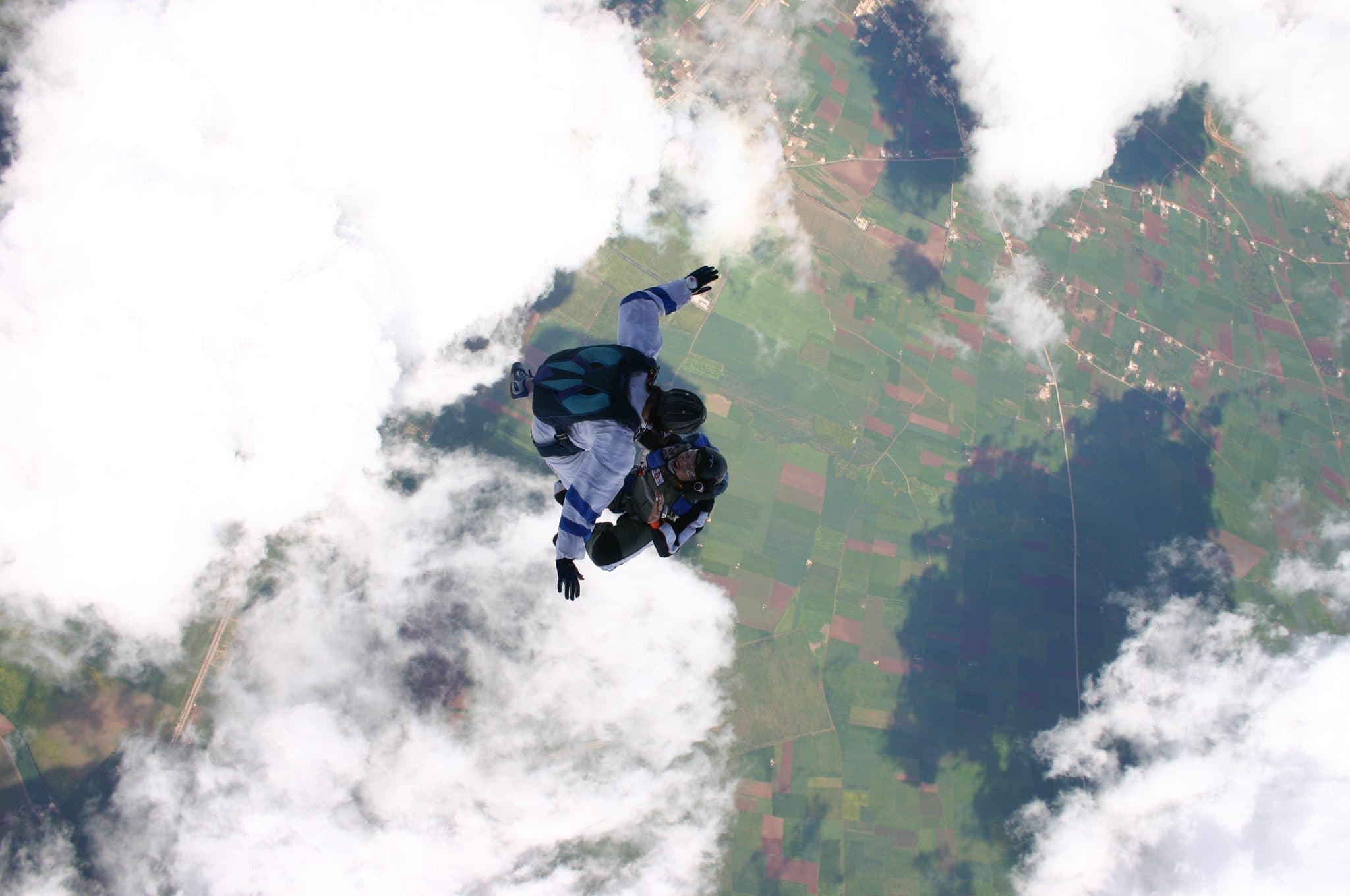
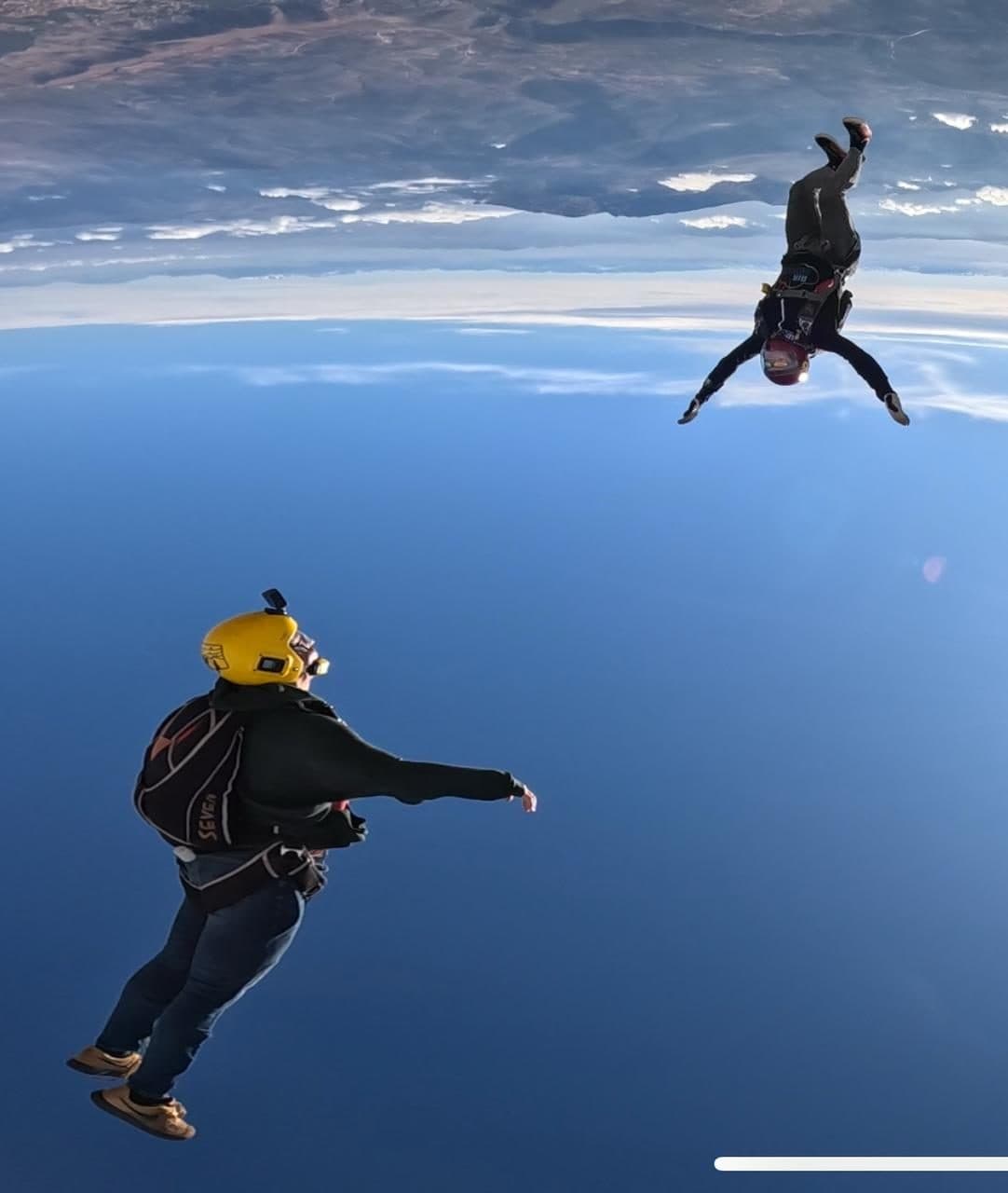
Once the pair is stable, you're flat, facing the ground, supported by the air like a giant cushion. Here's what those 50 or so seconds of freefall at close to 200 km/h feel like.
The noise
A continuous, exhilarating roar: the wind rushing past your helmet. Imagine sticking your head out of a car window on the motorway, only much louder. No need to talk: your instructor communicates with gestures, like the tap on the shoulder that tells you to spread your arms wide and enjoy it.
Wind and pressure
The wind is powerful, never violent. It presses evenly across your whole body, like a mattress of air you're lying on. Stretch out a hand and you'll feel it "lean" on the air – that's how skydivers move and turn. Your cheeks ripple and your lips dry out. Open your mouth and the air rushes in, which is why skydiving videos show such enormous grins.
That air pressure creates the most astonishing feeling of all: it feels like flying, not falling.
The cold
Despite the chilly air at altitude, the cold almost always goes unnoticed in freefall. Freefall is short, the jumpsuit provided by the club protects your body, and adrenaline does the rest. Only your hands and face are really exposed. On winter mornings, two thin layers under the jumpsuit are all you need to stay perfectly comfortable.
Breathing
Yes, you can breathe while skydiving – completely normally. The air is there; it's just slightly thinner at altitude, which makes no difference over such a short time. The "breath taken away" feeling some people mention simply comes from the reflex of holding your breath at the exit. Our instructors' tip: shout for joy as you leave the plane! A shout empties your lungs and restarts your breathing automatically. After that, breathe through your mouth or nose, whichever you like, and enjoy.
Ears and pressure: avoiding skydiving ear pain
Reassuringly, for most people, their ears barely make themselves noticed. They react to changes in pressure just as on an airliner, and the Pilatus climbs gradually.
On the way down, pressure rises as you get closer to the ground, and your ears may feel slightly blocked under canopy. Three simple moves are enough to equalise:
- swallow or yawn, several times;
- pinch your nose and blow gently with your mouth closed until your ears pop;
- avoid jumping with a cold or sinusitis: congested Eustachian tubes struggle to equalise, and that's when ear pain kicks in. If in doubt, ask your doctor.
During freefall itself, the pressure changes quickly, but healthy ears adapt without fuss – you'll be far too busy enjoying the view.
The parachute opening: jolt or gentle?
Gentle, mostly: it's a firm but progressive slowdown spread over a few seconds, taking you from close to 200 km/h to a peaceful descent. Modern parachutes open smoothly thanks to a piece of fabric called a slider, which slows the canopy's deployment.
Here's what you feel, in four beats:
- Your instructor deploys the parachute. You hear a rustle of fabric.
- The pair slows down noticeably over a few seconds. The harness tightens around your thighs and shoulders.
- You swing from horizontal to sitting upright.
- The roar stops almost instantly, and the magic of the silence begins.
On video, the skydiver seems to shoot upwards. That's an illusion: the camera flyer is still in freefall. You are simply slowing down.
With a properly fitted harness, the opening feels comfortable. That's why your instructor takes the time to tighten your straps well before the exit: a few seconds of adjustment on the plane for a smooth, gentle opening.
Under canopy: silence, the view, and possible motion sickness
After the roar comes silence. For many people this is the most moving moment of the jump. You hear the gentle wind in the canopy, your own voice, your instructor's. At last you can talk and share what you're feeling.
The view takes on its full scale. In Beni Mellal, the Tadla plain stretches out on one side and the peaks of the Middle Atlas, often snow-capped in winter, rise on the other. You're sitting in the harness like a swing, legs dangling in the air, and it's surprisingly comfortable.
Fancy some thrills? Your instructor can throw in a few turns or a spiral: a force presses you into the harness, like a fairground ride on a bend, and it's exhilarating! Prefer a scenic glide? Just say so – you choose. And if you're prone to motion sickness (nausea, cold sweat), a few simple reflexes do the trick:
- just tell your instructor, and they'll switch straight to calm, straight flight;
- look at the horizon rather than the ground;
- breathe deeply in the fresh air.
These minor discomforts usually fade soon after landing. The best prevention: a light meal a few hours before the jump – neither a feast nor an empty stomach.
Is skydiving worth it?
Yes – and that's what the vast majority of first-timers tell us the moment they land. For €250 (2,500 MAD for Moroccan residents) you get a 15 to 20-minute climb facing the Atlas, about 50 seconds of freefall and 5 to 7 minutes under canopy – sensations no theme-park ride or simulator truly reproduces. The only question left: when are you coming?
Here's our view as instructors, so you get 100% out of your jump.
| Go for it if… | The little extra to enjoy it to the full |
|---|---|
| You've always dreamed of knowing what freefall feels like | Come in great shape: with no cold or sinusitis, your ears stay perfectly comfortable |
| You want a powerful memory to share, or a gift that really lands | Prone to motion sickness? Tell your instructor: they'll adapt the canopy flight |
| You're looking for a winter-sun experience during a stay in Morocco | Keep a little flexibility in your plans: if the weather interferes, rebooking is free |
| You're wondering whether to learn to skydive solo – a tandem is a superb way to discover freefall | Check the two tandem requirements: 90 kg maximum dressed and a medical certificate (or the on-site check-up) |
What makes a skydive unforgettable isn't just the freefall. It's the whole thing: the climb facing the Atlas, the door opening, the roar and then the silence, and the grin you can't wipe off when you touch down. Many passengers add the video option to relive it all – our guide is a skydiving video worth it? helps you decide.
And if fear is still holding you back, here's the good news: it almost always gives way to wonder in the first seconds of freefall. Our article on being scared of skydiving explains why. Ready to live it? Book your tandem skydive: the season runs from 1 December 2026 to 31 March 2027, every day from 8:30 am to 6 pm, with free rebooking if the weather is bad.
Afterwards: adrenaline, endorphins and the urge to go again
Once you're on the ground, it's time for the euphoria! Adrenaline, endorphins and dopamine produce what skydivers call the post-jump high: a grin that won't go away, an urge to tell everyone, legs still a little wobbly. Some people laugh, others shed a happy tear. It's the best side effect of the jump.
A few hours later, a pleasant tiredness often sets in – the kind that follows a great day. The ideal plan: lunch in the caidal tent by the runway, then a relaxed evening if you're driving back.
And almost always, one thought keeps coming back: doing it all again! To relive the sensations again and again, a video of your jump is the perfect keepsake – our guide to skydiving video helps you pick the right option. For the facts and figures on timing and speed, see how long is a skydive?, and for the full jump-day sequence, read how does tandem skydiving work?.
Here in Beni Mellal For many people the best moment comes under canopy: the silence, the Tadla plain and the often snow-capped ridges of the Middle Atlas right in front of you, in the winter sun. As an FFP-approved club founded in 2000, we take you to 4,000 m aboard the Pilatus PC-6. Discover our tandem skydive from 4,000 m and book your jump for the winter season, from 1 December to 31 March.