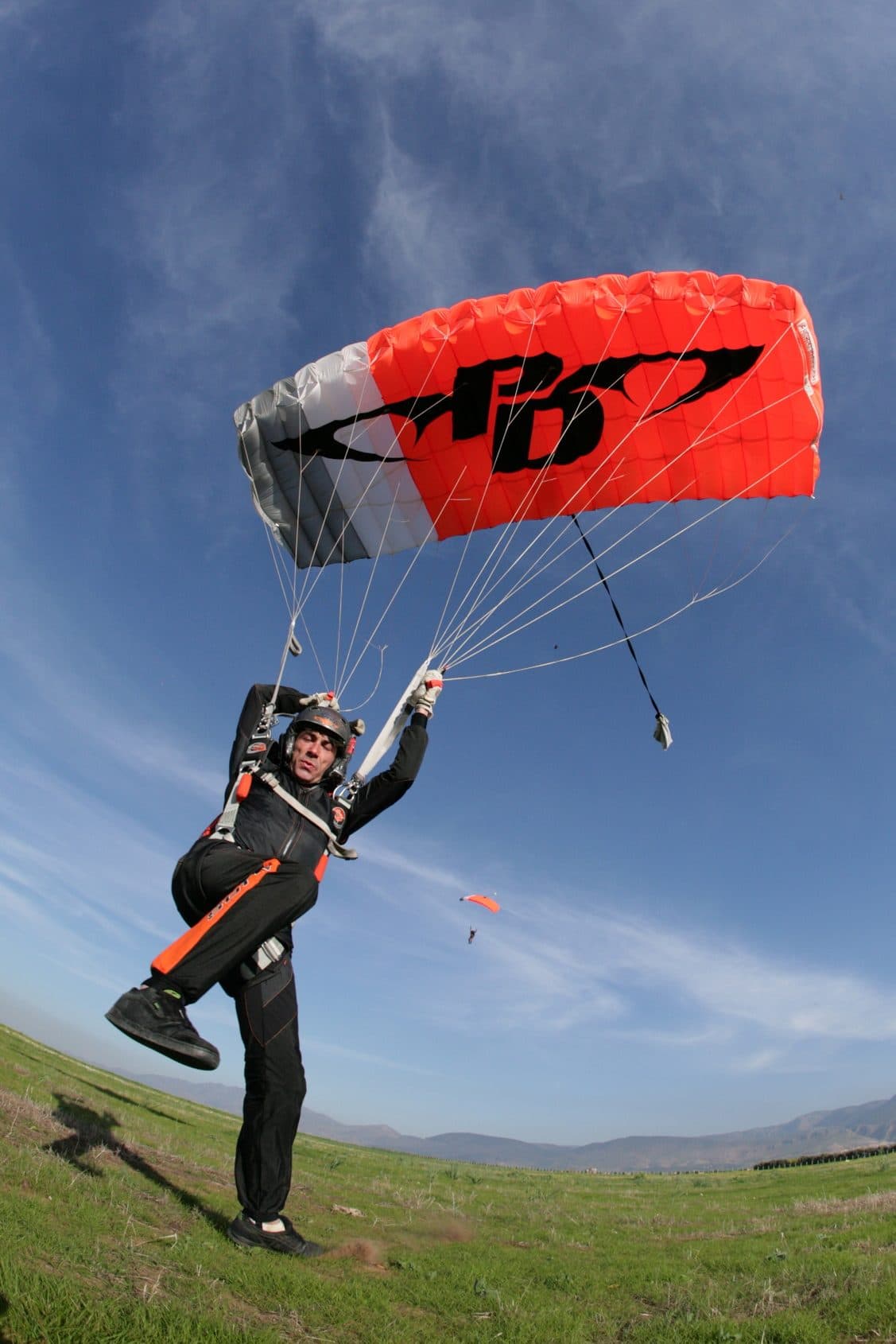
Skydiving with a disability: yes, it's often possible, and that's wonderful news! Paraplegic, amputee and deaf people have all experienced freefall as a tandem, and adaptive skydiving has been growing in France for more than a decade. Every project is built case by case, between you, your doctor and the dropzone: that's the rule on our tandem skydive page, where we invite you to contact us before you book. Here is what really matters, and how to prepare your request so you can move quickly towards your jump.
Is it possible? The case-by-case principle
Often, yes! There is no list of "allowed" or "banned" disabilities: a tandem relies on a few specific requirements (holding the position at the exit, lifting your legs for landing, a well-fitted harness, communicating by signs). For each one, the aim is to find the solution that lets you jump safely.
So the question your instructor asks is simple and positive: how can I give this passenger a safe jump, at every stage, with the equipment available?
Governing bodies think exactly the same way. In the UK, British Skydiving's tandem medical declaration states that having a listed condition does not necessarily mean you cannot jump, but that you should first get qualified medical advice (form 115A, as hosted by Skydive Tilstock). In France, the French Parachuting Federation (FFP) has run an adaptive sports programme since 2013, opening skydiving, tow-launched parachuting and wind tunnel flying to disabled people (Sportmag).
In practice, the answer rests on three things: your physical situation, the instructor's experience with passengers who have specific needs, and the kit available on the day. That is why a reputable dropzone takes the time to talk with you: that conversation is the first step of your jump.
What matters: landing, harness, communication
Landing: the critical phase
On a standard tandem, the passenger lifts their legs for landing so the instructor can land on their feet or slide in on their seat. This is the point that needs the most care for anyone who cannot control their legs, because a leg that drops can catch the ground.
And solutions exist! An adapted suit designed by David Wilmotte of the Vertical Champniers club holds the feet in stirrups and the legs against the instructor's, preventing them from spreading and reducing the risk of hip dislocation; after deployment, a strap brings the passenger into a seated position for a sliding landing (Handicap.fr, 2013). The FFP has used several of these suits on dedicated courses.
The harness
The passenger harness adjusts at the shoulders, chest and thighs, and stays snug through freefall and the opening shock. An amputation, a prosthesis, an unusual body shape or fragile bones can change how it sits and spreads the load: by mentioning it before jump day, you let your instructor prepare everything for you. Weight is also a factor: for the reasons explained in our article on the skydiving weight limit, PACMA welcomes tandem passengers up to 90 kg fully dressed.
Exit and communication
The passenger must be able to get into the aircraft, move to the door with the instructor and arch on exit. They also need to understand and follow a few simple instructions: arch, lift your legs, head back. If any step needs an adaptation, you look for it together: that is exactly what the conversation beforehand is for. The full sequence of a jump is set out in our guide to how tandem skydiving works.
Sensory and hidden disabilities
Deafness. Good news: nobody can hear anything in freefall, the wind drowns everything out, hearing or not. Tandem communication already relies on touch and signals (a tap on the shoulder to spread your arms, for example). For a deaf passenger, it is simply a matter of rehearsing those signals carefully on the ground, ideally with a sign language interpreter. In 2013, a tandem event for deaf women was held at Lyon-Corbas, with instructors trained in French Sign Language (LSF) (Handicap.fr). Mention any hearing aid or implant: your instructor will tell you whether to remove or protect it.
Visual impairment. Freefall is felt with the whole body first: the wind, the speed, then the great silence after opening. A fully sensory experience. Preparation relies on tactile cues and clear verbal instructions before boarding.
Hidden disabilities. Epilepsy, diabetes, heart conditions, anxiety disorders, autism spectrum conditions, chronic illness: none of these show, but all of them matter. Some are medical contraindications; many simply call for tailored preparation (managing noise, waiting and the unexpected). Purely medical questions are covered in our article on skydiving medical requirements. The golden rule: tell the dropzone everything, even what seems trivial. The more your instructor knows, the better they can look after you.
Real stories and organisations
Public, verifiable examples that show how far the desire to fly can go.
- Dana Bowman, a member of the US Army's Golden Knights parachute team, lost both legs in a freefall collision in 1994. He was skydiving again a few months later (U.S. Army).
- The FFP ran its first "Parachuting and Disability" course at Vichy-Charmeil in 2013, with tandem jumps after medical clearance, and backs the HandiFly project, supported by the EU's Erasmus+ Sport programme since 2016 (Sportmag).
- In France, charities and fundraising schemes regularly fund tandem skydives for people with reduced mobility. Your national disability sports federation or a local adaptive sports club are excellent starting points.
Preparing your request to the club
A well-prepared request means a quicker, more precise answer. Before booking, send the club this information:
| Information | What it helps prepare |
|---|---|
| A short description of your disability | Every phase of the jump, adapted to you |
| Your mobility: can you lift and hold your legs up? Move around the aircraft unaided? | The landing and the exit, the heart of the assessment |
| Your weight and height | The equipment and harness fit |
| Prostheses, devices, medication | The best-suited kit |
| How you communicate | The signals you will use in the air |
| A medical opinion | Confirmation that there is no contraindication |
PACMA asks every tandem passenger for a medical certificate confirming there is no contraindication to skydiving. Without one, you can see the club doctor on site (200 MAD). If you have a disability, the most comfortable option is to get the opinion of a doctor who knows your situation before you travel: you arrive relaxed and ready to jump.
Here in Beni Mellal… Your jump starts with a conversation. Write to us via our contact page before you book, describing your situation using the table above: we look at your request carefully and give you a frank answer, with the adaptations that are possible. On the day, your friends and family are welcome at the edge of the runway to share the moment with you, facing the Atlas. General tandem requirements are on our tandem page, and quick answers are in our FAQ.